
Customer service AI Agent solutions are increasingly helping businesses automate tasks ranging from consultation and request handling to employee support. Rather than simply replying like a chatbot, an AI Agent can analyze context, retrieve data, and take actions within a workflow. So what benefits can AI Agents bring, and how should businesses implement them effectively?
What is a customer service AI Agent?
A customer service AI Agent is an artificial intelligence system capable of receiving requests, analyzing context, retrieving data, and taking actions based on defined goals. Unlike traditional chatbots that mainly respond according to scripts, an Agent can proactively look up information, update a CRM, classify customers, or route requests to the right employee.
A key strength of a customer service AI Agent is its ability to connect multiple tools within a single process. When deploying an AI Agent for customer service, businesses can build a “digital assistant” that works continuously while still following controlled data, policies, and permissions. This makes Agents well suited to multi-step customer service processes that need to handle large volumes of requests.
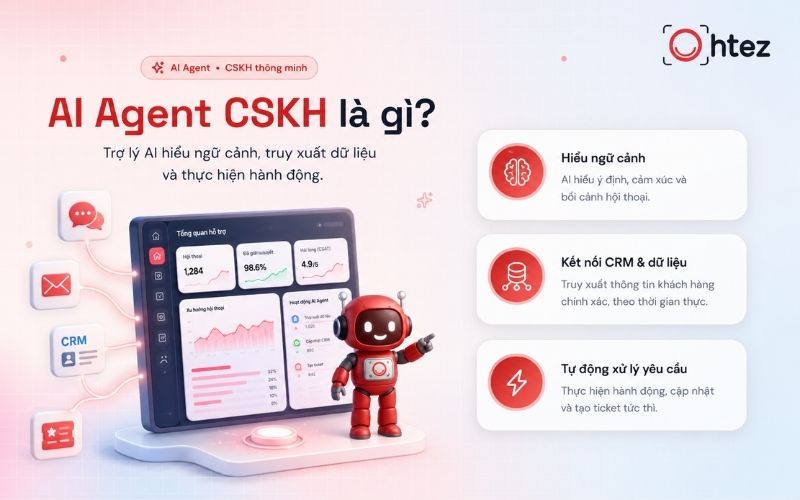
A customer service AI Agent can receive requests, retrieve data, and take actions within a workflow
>> See also: AI Agent Skills explained: Concepts, how they work, and detailed examples
Why should businesses use AI Agents in customer service?
Customers increasingly expect fast, accurate, and consistent responses across multiple touchpoints. As request volumes grow, businesses need more than additional staff to answer questions; they need a system that can receive, analyze, and process tasks according to a defined workflow. A customer service AI Agent helps automate suitable tasks while enabling the team to focus on more complex situations.
- Automate repetitive requests: A customer service AI Agent can receive requests, retrieve information, and carry out workflow steps such as checking orders, providing product information, or explaining policies.
- Personalize interactions using context and data: Instead of giving only generic answers, a customer service AI Agent can reference authorized data, interaction history, and the current context to provide more relevant responses or take more appropriate actions.
- Handle higher volumes without proportional headcount growth: By taking on tasks with clear processes, a customer service AI Agent helps businesses manage more requests, reduce manual work, and allow employees to focus on situations that require judgment.
- Connect and coordinate across multiple channels and systems: A customer service AI Agent can work with a CRM, website, or other business tools to retrieve, update, and pass information through workflows rather than acting only as a response tool on a single channel.
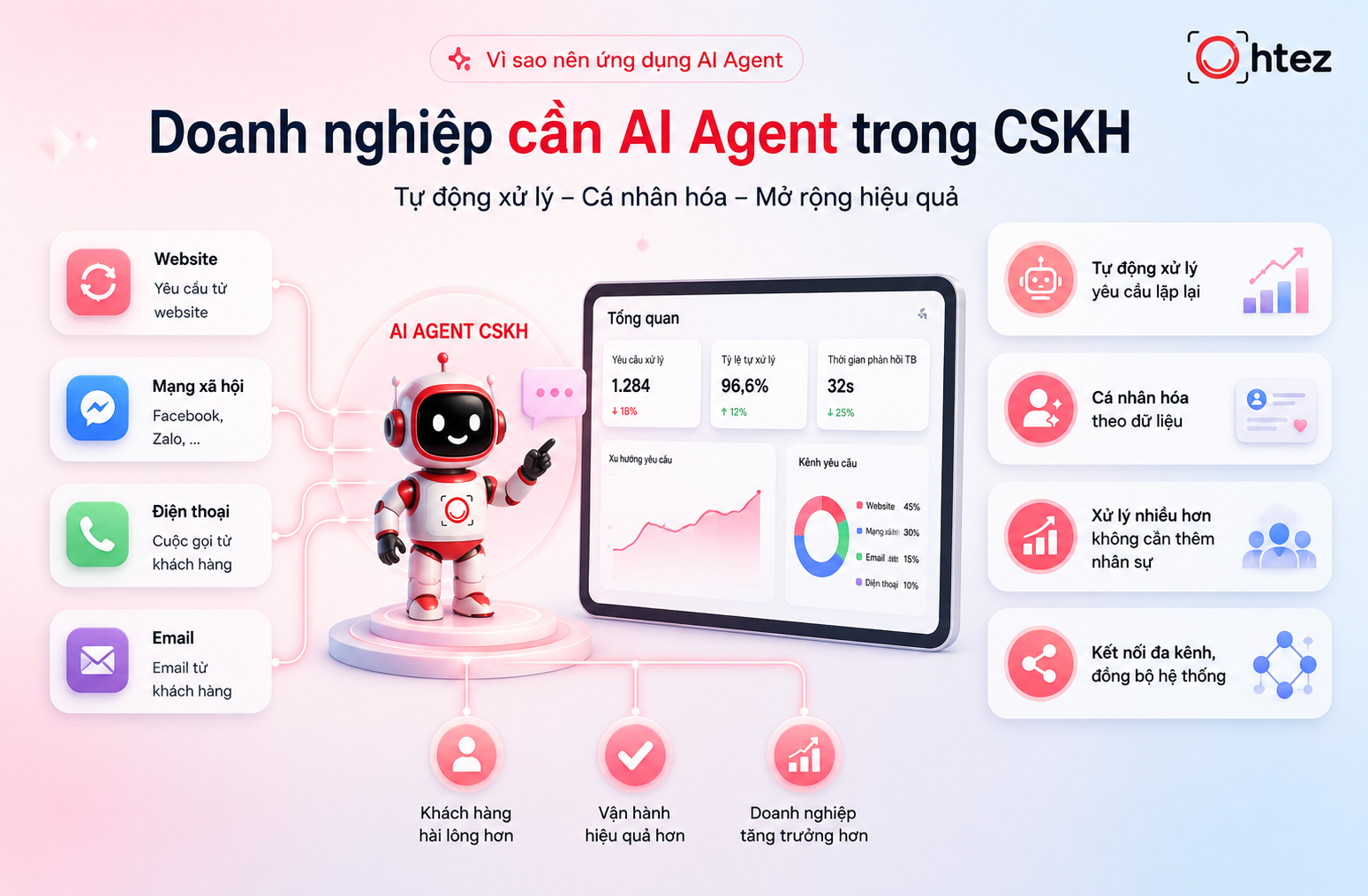
Using an customer service AI Agent helps businesses handle rising request volumes without proportionally expanding headcount
Benefits of an customer service AI Agent
A customer service AI Agent helps businesses automate repetitive tasks, process data, and support employees throughout customer service operations. When integrated properly, AI can improve efficiency while helping the business maintain a consistent customer experience.
- Provide 24/7 customer responses: A customer service AI Agent can receive and answer common questions about products, orders, and policies at any time. More complex issues can be escalated to an employee for handling.
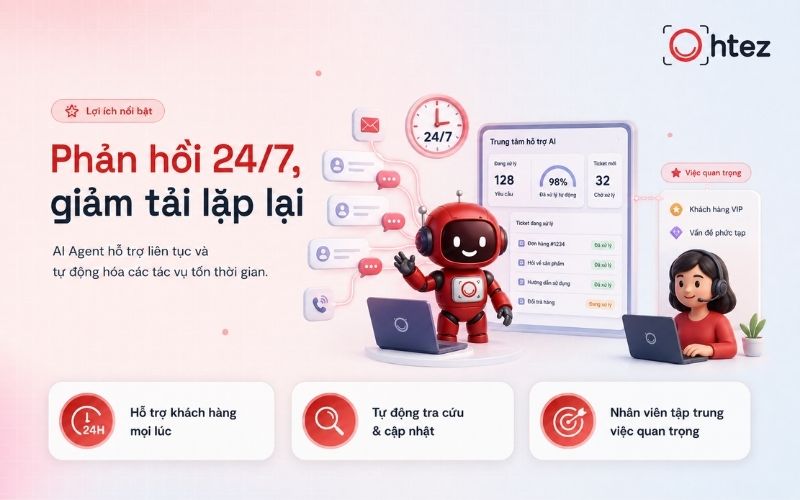
A customer service AI Agent can respond to customers 24/7 for common questions about products and policies
- Reduce repetitive workloads: AI can automatically look up orders, send instructions, or update information. By applying AI to customer service, employees have more time to focus on consultation and exceptional cases.
- Synchronize the omnichannel experience: When connected to websites, email, social networks, and messaging platforms, a AI Agent for customer service helps keep information consistent and reduces the need for customers to repeat data when switching channels.
- Improve customer service team productivity: A customer service AI Agent can assist with information retrieval, conversation summaries, request analysis, and suggested replies. Employees still control important decisions while significantly reducing handling time.
- Personalize interactions: Based on authorized data, a customer service AI Agent can reference interaction history, products of interest, and the customer journey to provide more relevant responses or recommendations.
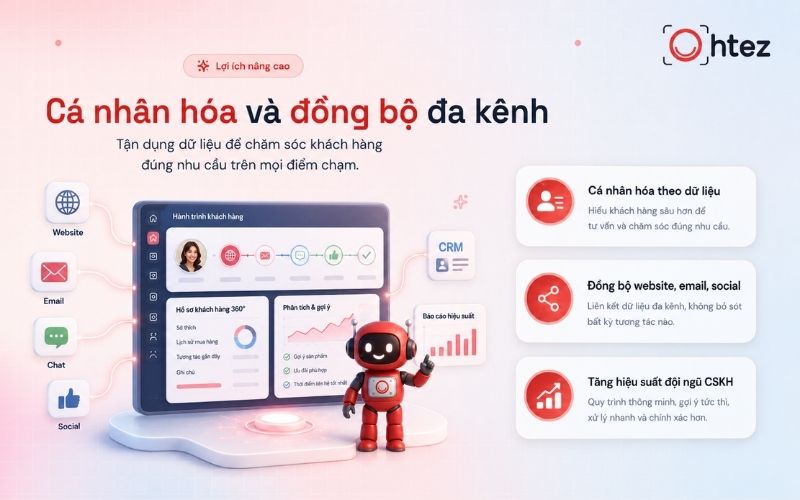
Customer service teams become more productive with an Agent that can retrieve information, summarize conversations, and suggest responses
>> See also: Top 10+ most powerful AI Agents for performance optimization in 2026
Common applications of AI Agents in customer service
In practice, a customer service AI Agent can support many stages of the service process, from consultation and request handling to employee assistance. Businesses can start with simple tasks and gradually expand the scope once the system is stable. When implementing AI-powered customer service, it is important to define access permissions, processing scope, and escalation mechanisms so the AI operates within its intended role.
1. Automated consultation and Q&A with an AI Agent
A customer service AI Agent can automatically answer questions about products, services, policies, or procedures using internal data. The Agent can maintain context to provide responses that fit each request. When deploying an AI Agent for customer service, businesses should begin with common questions that have clear answers, then gradually expand to more complex consultation scenarios.

An AI Agent can provide automated consultation and answers using internal data while maintaining context for each request
2. Using an customer service AI Agent to automate emails and messages
A customer service AI Agent can analyze emails and messages to identify intent, classify requests, and suggest suitable responses. The Agent can also assign priority levels so employees can quickly identify urgent cases. By applying AI to customer service, businesses can reduce manual screening time and lower the risk of requests being missed or handled too slowly.
3. Using AI Agents to analyze customer sentiment and satisfaction
A customer service AI Agent can analyze conversation content and feedback to identify positive or negative customer signals. Patterns such as repeated complaints, negative language, or a rising risk of escalation can trigger alerts. In an AI-powered customer service model, these results should be treated as reference signals that help employees identify cases requiring priority attention.
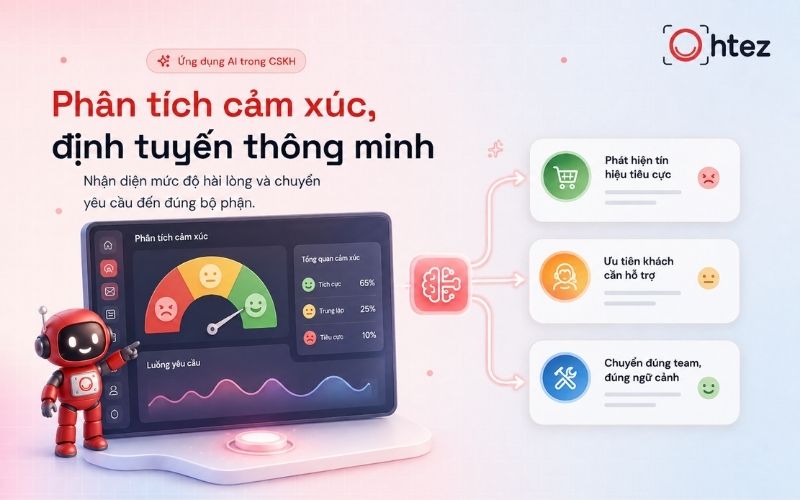
A customer service AI Agent can analyze sentiment and satisfaction levels to flag potential complaint risks
4. Routing requests to the right department with an AI Agent
A customer service AI Agent can analyze a request to identify the responsible department based on the issue type, product, or priority level. The Agent routes requests automatically instead of relying on manual triage, helping shorten response times. With an AI Agent for customer service, the conversation history can also be transferred with the request so the receiving team quickly understands the issue without asking the customer to explain it again.
5. Automating customer complaint handling with an customer service AI Agent
Some steps in the complaint process, such as receiving information, verifying an order, creating a request, and updating its status, can be handled automatically by a customer service AI Agent. This speeds up the process and reduces the risk of missing information. However, when applying AI to customer service, businesses need to define clear Agent boundaries and hand cases involving compensation or disputes over to employees.
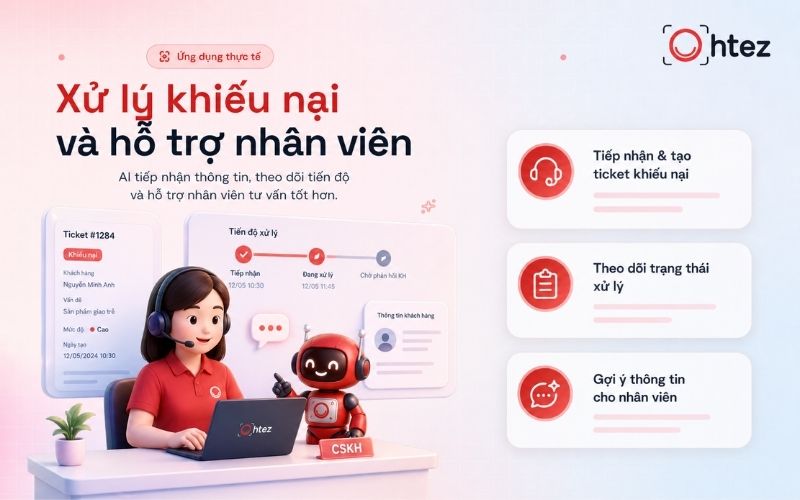
AI Agents can help automate complaint handling by receiving information, verifying orders, and updating case status
6. Supporting service staff during consultations with an customer service AI Agent
A customer service AI Agent can act as an assistant, helping employees search documents, summarize conversation history, and suggest next steps. This approach to AI-powered customer service is suitable for businesses that are not ready for full automation. Employees retain control over the final response, while the Agent handles information search and synthesis to reduce processing time and improve productivity.
Process for implementing an customer service AI Agent
Effective implementation of a customer service AI Agent should begin with actual processes and business needs rather than choosing the technology first. Businesses should identify bottlenecks, required data, and the metrics they want to improve. An AI Agent for customer service project should start with a limited scope, measure results, and expand only after performance is validated to reduce risk.
>> See also: How to build an AI Agent for technical-grade automation [Complete 2026 guide]
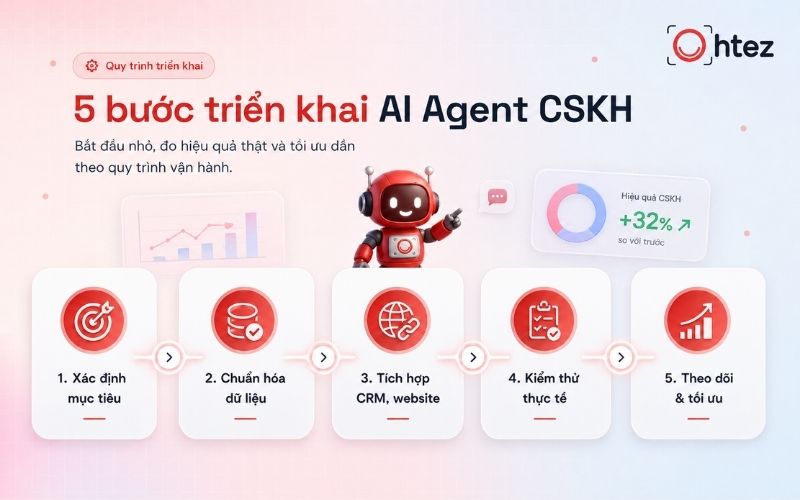
Step 1: Define the goal and scope of automation
First, the business needs to identify the problem the customer service AI Agent should solve, such as long response times or a high volume of repetitive questions. When applying AI to customer service, it is better not to automate everything from the outset. The Agent should first be tested on low-risk tasks with clear rules and available data so performance can be controlled more easily.
Step 2: Standardize customer service data and scenarios
The quality of a customer service AI Agent depends heavily on the data it receives. Businesses should standardize FAQs, policies, product information, processes, and exception cases. Data used for AI-powered customer service should also be access-controlled and updated regularly. Clear and consistent information helps the Agent avoid relying on outdated documents or giving unsuitable guidance.
A customer service AI Agent needs standardized FAQs, policies, and processes to operate accurately
Step 3: Integrate the AI Agent with CRM and website
A customer service AI Agent delivers more value when connected to CRM, website, and operational tools instead of working in isolation. Integration allows the Agent to retrieve data and perform authorized tasks. An AI Agent for customer service can check customer information, update statuses, or trigger workflows, but authentication mechanisms and access limits should be in place.
Step 4: Test before production deployment
Before serving real customers, a customer service AI Agent should be tested across a range of scenarios, including common questions, missing data, and out-of-scope requests. When applying AI to customer service, businesses should define evaluation criteria for accuracy, response time, and successful escalation to employees. The Agent should expand its scope only after important scenarios have been tested and shown to perform reliably.
Step 5: Monitor and optimize Agent performance
After deployment, a customer service AI Agent should be monitored using metrics such as response time, successful resolution rate, employee escalation rate, and customer satisfaction. Operational data helps businesses identify situations the Agent does not handle well. They can then update the knowledge source, adjust workflows, or refine action permissions so AI-powered customer service becomes increasingly aligned with real operating needs.
Risks of using AI Agents in customer service
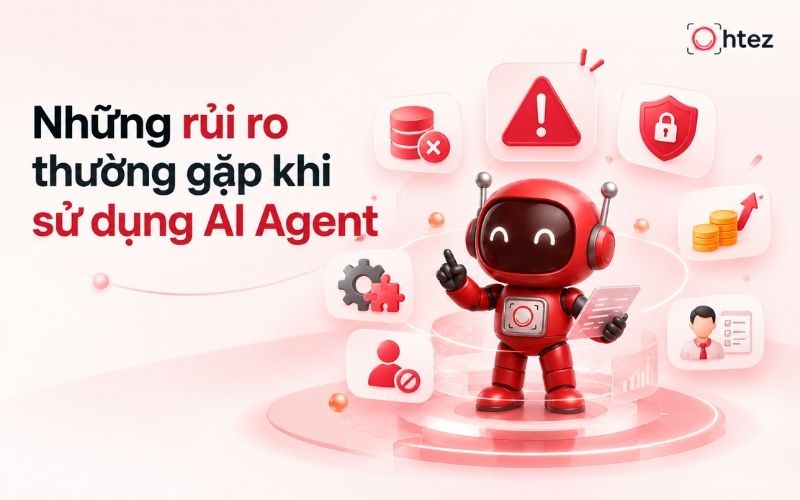
Despite its benefits, a customer service AI Agent can still create risks when data and control mechanisms are inadequate. Businesses should clearly define the Agent’s operating scope and the point at which a case must be transferred to a human employee.
- Incorrect or context-poor responses: Missing or outdated data can cause an customer service AI Agent to provide inaccurate information. Complex cases should be transferred to an employee.
- Data security risks: A AI Agent for customer service may have access to personal information and transaction history. Businesses should control permissions carefully and provide only the data that is necessary.
- Overreliance on automation: Excessive use of AI in customer service can make the experience feel less personal. AI should handle repetitive tasks, while employees take responsibility for situations that require judgment.
- Insufficient escalation to employees: When an Agent does not understand a request, continuing to respond can frustrate the customer. A customer service AI Agent needs an escalation mechanism that transfers the conversation history along with the case.
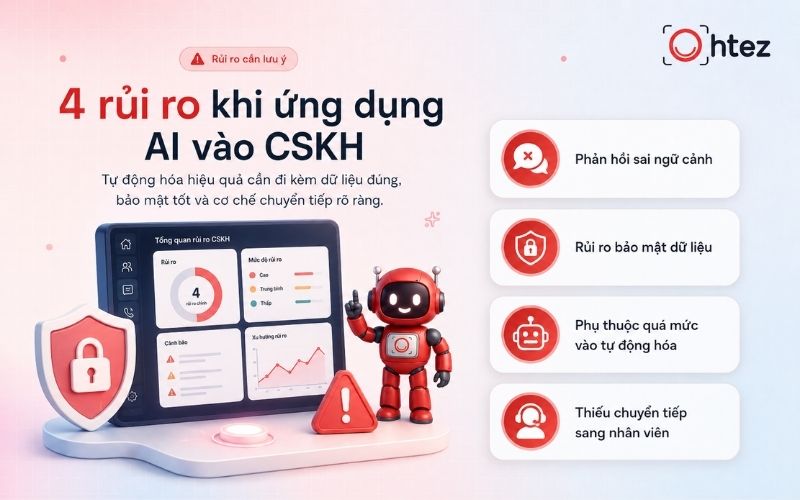
Risks of using AI Agents in customer service include context errors, data security issues, and insufficient escalation mechanisms
Design a custom customer service AI Agent for your business with Ohtez
Every business has different processes, data, and operating systems, so a customer service AI Agent should be built around real business requirements rather than a prebuilt script. Ohtez develops AI Agents around custom goals and workflows, allowing an Agent not only to answer questions but also to analyze information, select the next processing step, connect tools, and perform authorized tasks.
Key strengths of Ohtez’s AI Agent for customer service solution include:
- Designed around custom workflows: The Agent is built around the business’s specific processes and goals instead of applying the same model to every situation.
- AI does more than answer questions – it takes action: The Agent can use APIs, retrieve data, update CRM records, or coordinate multiple tools to complete a goal rather than simply generate a reply.
- Connects with business systems: Ohtez supports integration with platforms such as Google Sheets, HubSpot, Shopify, Meta, ERP and systems with APIs, allowing AI Agents to work directly with the data and tools a business already uses.
- Combines AI Agents and workflows: Not every task requires AI to make a decision. Ohtez can use workflows for fixed steps and AI Agents for stages that require analysis, reasoning, and adaptation, balancing operational stability with automation capabilities.
- Controls permissions and actions: Businesses can define the data, tools, and actions an Agent is allowed to use, together with approval steps and monitoring mechanisms to reduce automation risks.
- Support from implementation through optimization: Ohtez not only builds the system but also supports needs assessment, consulting, implementation, training, and post-launch optimization.
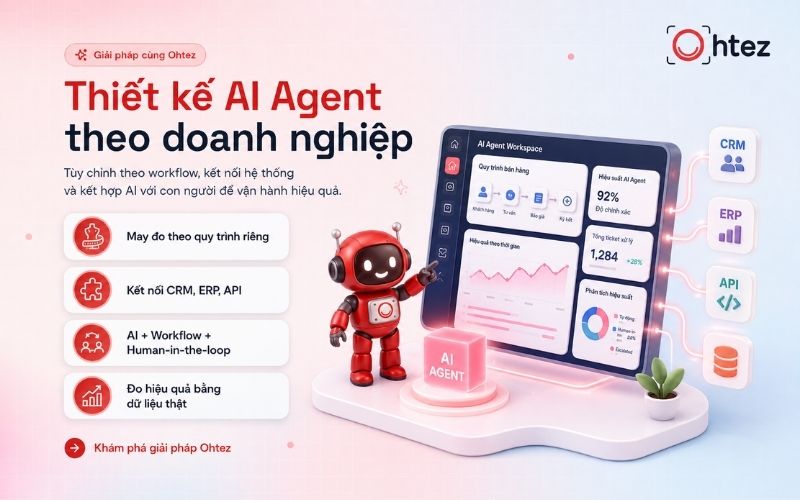
Ohtez designs a custom customer service AI Agent around each business’s workflows and existing systems
A customer service AI Agent helps businesses improve productivity, reduce repetitive workloads, and enhance the customer experience. However, results depend on data quality, processes, and how the Agent is controlled. Businesses should begin with a specific workflow, measure results, and expand step by step. With workflow-based customization, Ohtez can help businesses bring AI into real customer service operations and scale it more easily as demand grows.