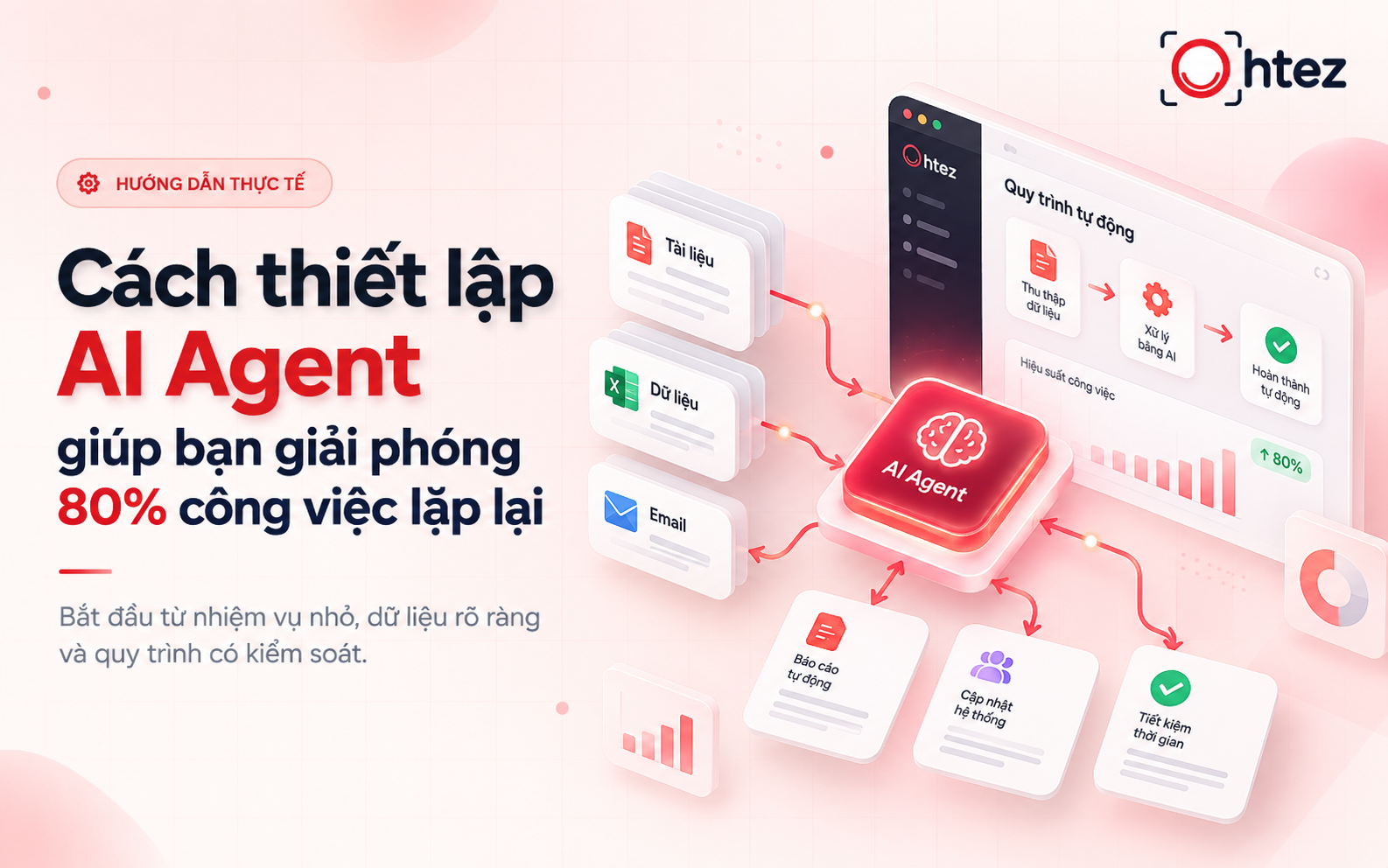

AI Agents are driving a major leap in operational productivity through their ability to make decisions proactively and execute automated workflows. However, without a sound governance strategy, organizations can face serious consequences involving security, finances, and brand reputation. Identifying the common risks of using AI Agents early is therefore essential for managers to build robust safeguards around the system.
Common risks of using AI Agents
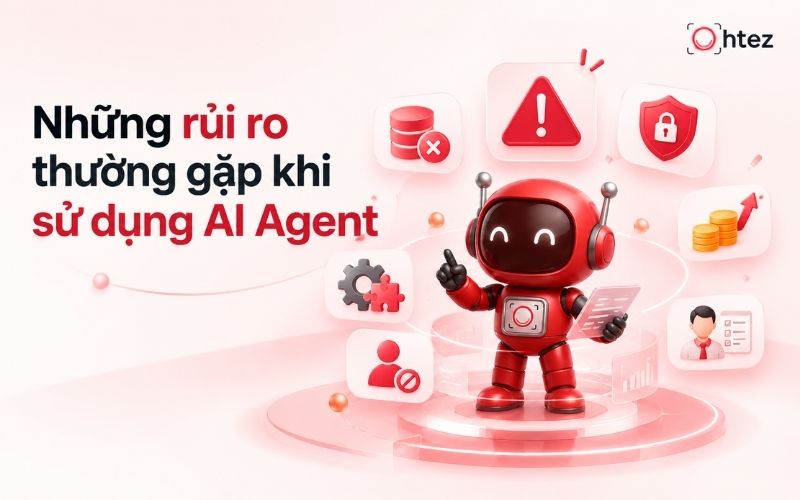
common risks of using AI Agents and how to mitigate them
Workflow automation requires a high degree of caution when AI agents are granted direct access to system resources. Businesses should understand the eight common risks of using AI Agents below so they can establish appropriate controls before moving into real-world operations.
1. Data quality and bias risks

Data quality and bias risks
Data quality directly affects system accuracy and decision-making. When input information is fragmented, duplicated, or outdated, the AI agent can produce distorted analysis. This is one of the leading common risks of using AI Agents in business analytics, financial forecasting, and customer management. Two common forms of data distortion that need to be controlled are:
- Data bias: Training data contains pre-existing bias, which can lead to discriminatory or insufficiently objective recommendations.
- Data drift: Real-world market behavior changes over time, but the datasets supplied to the system are not updated quickly enough.
To minimize the common risks of using AI Agents related to data, businesses should clean raw information, diversify data sources, and establish a recurring validation cycle.
2. Information leakage and data security risks
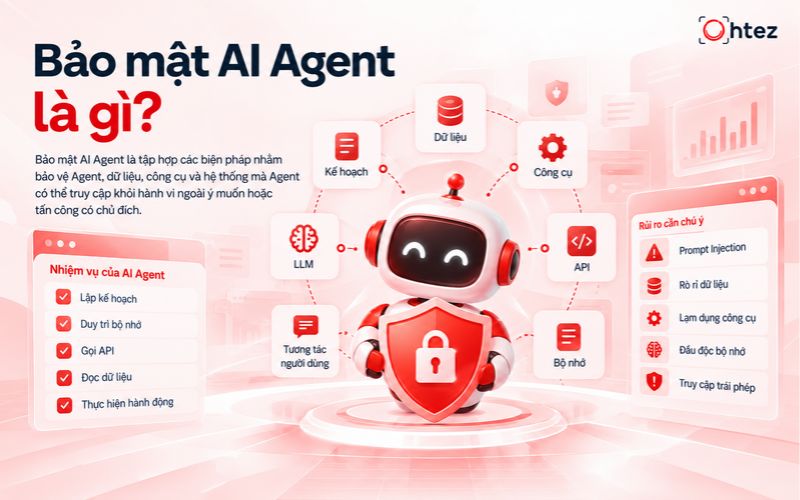
The exposure of confidential information is one of the common risks of using AI Agents when the system is connected directly to CRM platforms, email, and internal databases. Attackers may exploit techniques such as Prompt Injection—embedding malicious instructions in input documents—to push an Agent into unintended actions or unauthorized data extraction. To control this group of risks, organizations should establish security safeguards from the outset:
- Multi-layer encryption: Protect sensitive data both at rest and in transit, and minimize sending raw data to third-party platforms.
- Input validation: Strictly inspect files, emails, and external requests before allowing the Agent to process them.
- Audit log monitoring: Store and monitor activity logs in real time to identify and respond early to abnormal queries.
3. Excessive access permissions

Excessive access permissions
Loose permission management can trigger many of the common risks of using AI Agents in day-to-day operations. Without the principle of Least Privilege, an Agent assigned only to read reports may still unintentionally have permission to write, edit, or delete critical order data. To prevent risks arising from access-control gaps, businesses should:
- Define role boundaries: Grant access only to the folders and APIs required for each Agent’s specific task.
- Set up an approval gate: Require direct confirmation from the responsible person before sensitive actions such as deleting records, transferring funds, or changing server configurations.
- Isolate the environment: Separate Agent operating accounts from high-level system administrator accounts.
4. Inaccurate AI Agent decisions
Despite strong processing capabilities, AI systems can still experience AI hallucinations—generating unsupported information while presenting it in a highly convincing way. This is one of the common risks of using AI Agents that can directly damage brand reputation, such as when a support bot gives incorrect warranty guidance or applies a discount beyond the authorized limit. Ways to reduce decision-related risks include:
- Grounding: Require the Agent to retrieve information only from an approved internal knowledge base instead of relying on unsupported inference.
- Build a test scenario set: Continuously test edge cases to identify and correct weaknesses in reasoning logic.
- Use confidence thresholds: Configure the system to hand off a call or request to a human when the answer confidence falls below a safe threshold.
>> Read more: Top 10+ most powerful AI Agents for optimizing performance in 2026
5. Deployment and operating costs exceeding the budget

Deployment and operating costs exceeding the budget
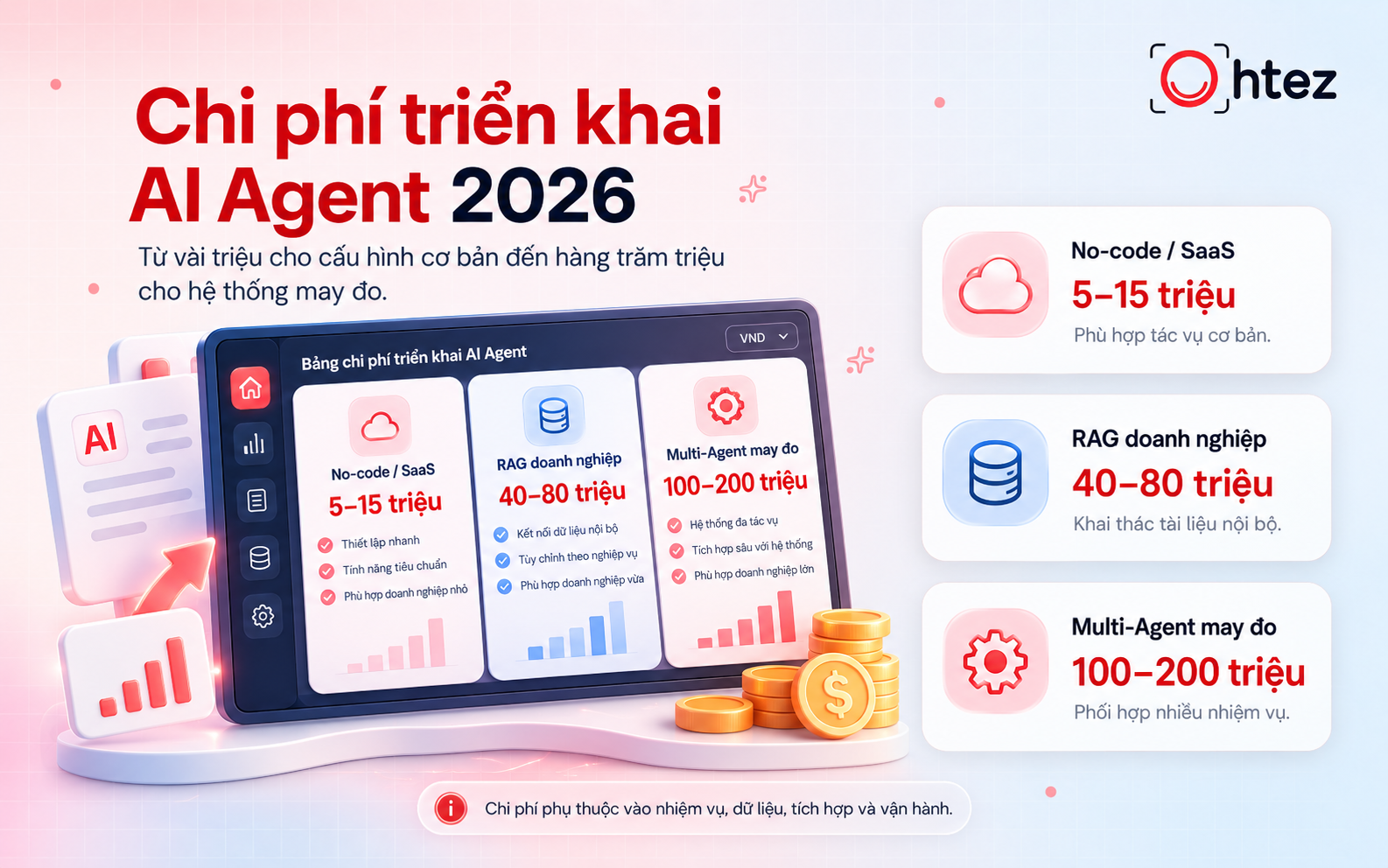
Many organizations face budget pressure because they underestimate infrastructure and model operating costs. Infinite loops—where an Agent repeatedly tries to resolve an error—or sudden spikes in long requests are common risks of using AI Agents that can cause cloud computing and language-model API bills to rise uncontrollably. Businesses can manage financial risk through the following steps:
- Set a hard cap: Limit maximum spending directly in the API provider’s billing portal on a daily and monthly basis.
- Optimize model selection: Use smaller, lower-cost models for basic classification tasks and reserve premium models for more complex work.
- Measure ROI regularly: Compare actual API costs with time saved and value created so the scale can be adjusted in a timely manner.
6. Difficulty integrating with existing management systems
Architectural conflicts between new AI platforms and legacy systems can easily create operational barriers. Without compatibility, data across CRM, ERP, and accounting software may become fragmented, creating one of the common risks of using AI Agents by disrupting workflows and causing information inconsistencies across departments. A practical integration-risk mitigation process includes:
- Assess communication standards: Evaluate the availability of Open APIs and technical documentation across the current software stack.
- Standardize data structures: Align input and output formats across modules before connecting the Agent.
- Deploy in stages: Test individual integrations in narrow workflows to resolve conflicts thoroughly before broader rollout.
>> See also: What is AI Agent Clawbot? How it works and a detailed usage guide for 2026
7. Platform and vendor dependence

Platform and vendor dependence
Vendor lock-in occurs when data, prompts, and automation workflows become tightly tied to a single platform. If the provider changes pricing, updates policies, or experiences an outage, the business bears the full impact of process disruption. To avoid the common risks of using AI Agents caused by this dependence, organizations should:
- Prioritize flexible architecture: Design a modular system that allows easier switching between model providers such as OpenAI, Anthropic, and open-source options.
- Store data independently: Keep prompts, configuration documents, and knowledge data under the organization’s own control.
- Build fallback procedures: Prepare semi-automated or manual workflows so operations can continue when a third-party service becomes unavailable.
8. Lack of human oversight, control, and accountability
Overreliance on technology without a clearly responsible person is a root cause of serious incidents. This is one of the common risks of using AI Agents driven by human factors, where small mistakes accumulate into operational crises because employees fail to review results and rely too heavily on automation. To reduce the risks caused by weak governance, businesses should adopt:
- Human-in-the-loop: Keep a human as the final approver for decisions involving finance, legal matters, and user experience.
- Clear accountability: Assign a dedicated owner to each Agent to monitor performance and take responsibility for incidents.
- Collaborative working culture: Establish clear operating standards and treat AI Agents as productivity tools rather than complete replacements for human oversight.
>> Read more: How to use AI Agents: A detailed beginner’s guide for 2026
Why AI Agent risks increase
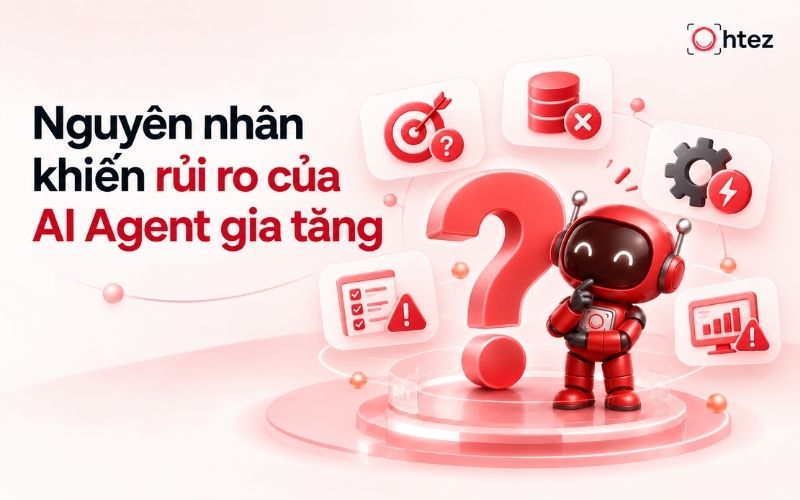
Why AI Agent risks increase
The common risks of using AI Agents do not arise only from technological limitations; they are also closely related to how businesses design and govern their systems. When AI Agents are deployed without a clear plan, small errors can spread across multiple activities. Key causes include:
- Unclear objectives: The business has not defined the Agent’s exact task, scope of work, or expected outcomes.
- Unstandardized data: Inconsistent data sources make it harder for the system to analyze information and execute requests correctly.
- Insufficient testing: The Agent is deployed directly without adequately evaluating abnormal scenarios.
- Over-automation: The system is allowed to perform important tasks without employee approval.
- Lack of monitoring: No tools are in place to track performance, activity logs, or alerts when incidents occur.
>> Read more: Step-by-step guide to creating an AI Agent on Gemini in 10 minutes
Pre-deployment checklist to reduce AI Agent risks
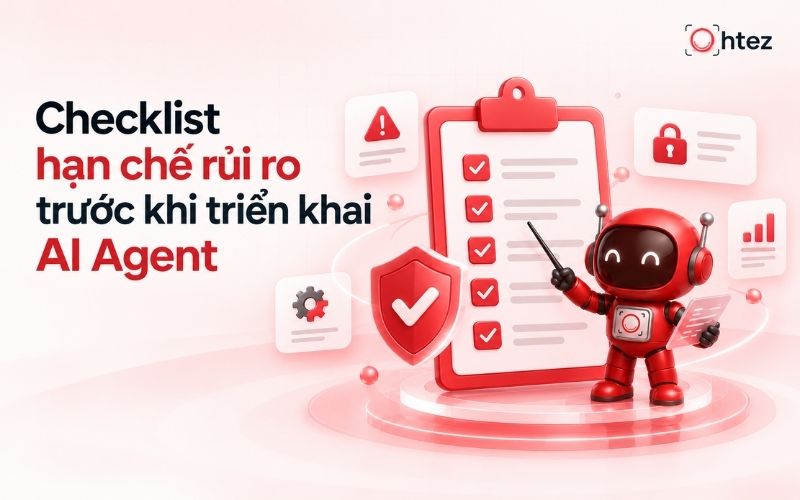
Pre-deployment checklist to reduce AI Agent risks
A standardized checklist helps businesses screen for and reduce the common risks of using AI Agents from the testing stage. This checklist acts as a practical safety framework for the organization and helps prevent unintended incidents. Following each criterion consistently can significantly reduce real-world risks:
- Validate the quality of all input data to identify sensitive information and inaccurate content before use.
- Apply least-privilege access policies so each specialized digital assistant receives only the permissions it actually needs.
- Set maximum spending limits in the billing portals of large language model providers.
- Require a human-supervised approval gate for every financial action or action that publishes information externally.
- Assign a responsible person to operate the Agent and review its activity logs regularly.
Deploy AI Agents safely with solutions from Ohtez
Deploy AI Agents safely with solutions from Ohtez
Ohtez provides custom AI Agent development services that help businesses automate work according to real operational workflows while maintaining control over system data and actions. Instead of applying packaged solutions with fixed functionality, Ohtez focuses on developing AI Agents around each organization’s operating model and objectives. Key advantages of deploying AI Agents with Ohtez include:
- Custom workflow design: Build AI Agents around specific business processes without requiring the organization to replace its entire existing workflow.
- Flexible integration with existing systems: Connect CRM, ERP, and API-enabled platforms to synchronize data and reduce manual work.
- Access and activity controls: Configure permissions, approval mechanisms, and monitoring based on business requirements to help reduce the common risks of using AI Agents.
- Optimized starting costs: Recommend and build an approach that fits the available budget, allowing businesses to adopt automation without investing in an overly complex system from the start.
- Support from deployment through optimization: Help monitor, adjust, and optimize AI Agent performance after go-live.
Intelligent automation powered by AI is becoming an inevitable business trend, but sustainable success must begin with preventing the common risks of using AI Agents. By standardizing data, applying least-privilege access, and maintaining human oversight, organizations can improve productivity with greater confidence while reducing the risk of information leakage and wasted resources. Ready to operate a safer automation model tailored to your business? Contact Ohtez today for an in-depth 1:1 consultation.