
AI Agents can respond quickly and carry out multiple tasks, but how can businesses tell whether these systems deliver real value? AI Agent performance evaluation should consider task completion, accuracy, automation, cost, and safety. In this article, Ohtez explores five essential metric groups, explains how to establish scoring criteria, and outlines a measurement process suited to business operations.
What is AI Agent performance evaluation?
AI Agent performance evaluation is the process of measuring task completion, output quality, and the value a system delivers under real-world conditions. An evaluation must consider not only the final result but also how the agent uses data, tools, and access permissions. A convincing response alone does not prove that a task has succeeded. For example, if an agent says an order has been updated but the system has not recorded the change, the task is still incomplete.
Unlike testing a question-answering chatbot, AI Agent performance evaluation requires tracking a sequence of actions across multiple steps. Businesses should define AI Agent evaluation criteria for each business process. The aim is to determine whether the system performs the right tasks, genuinely reduces workloads, and operates within authorized boundaries.
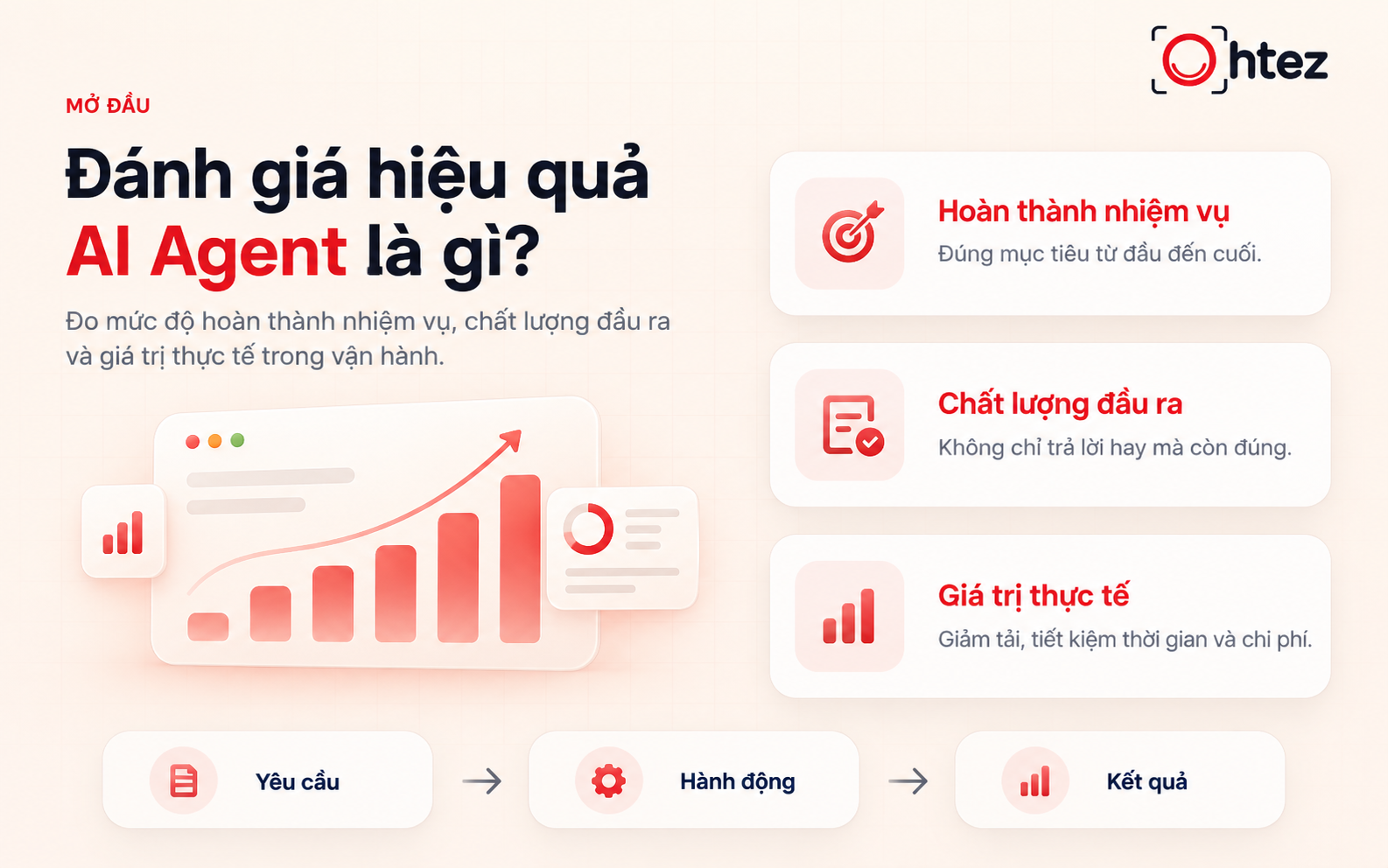
AI Agent performance evaluation based on tasks, outputs, and measurable business value
>> See also: Top 10+ most powerful AI Agents available today for optimized performance in 2026
5 key metrics for measuring AI Agent performance
To conduct an AI Agent performance evaluation, businesses must assess quality, autonomy, cost, and safety together. The following five metric groups help prevent conclusions based solely on response speed. When using AI Agent performance metrics, teams should agree on calculation methods and the scope of data being measured. This provides a consistent basis for AI Agent performance evaluation across test runs.
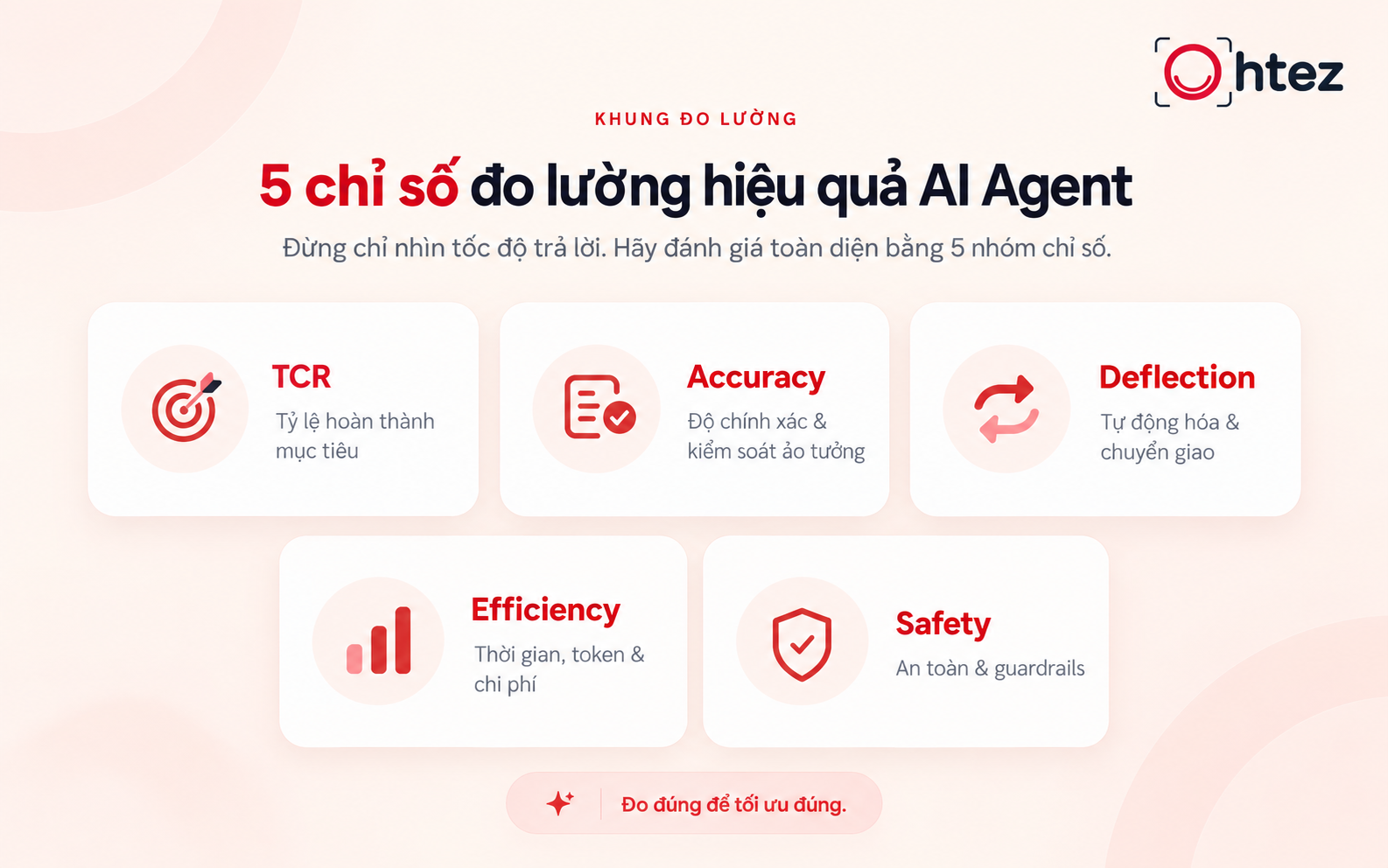
Five AI Agent performance metrics provide a comprehensive view of system effectiveness
1. Task completion rate (TCR)
TCR measures the percentage of assigned tasks an agent completes successfully and autonomously from start to finish. Success must be verified against actual outcomes, rather than relying on the system’s own completion message. The formula is: TCR = Number of successfully completed autonomous tasks / Total assigned tasks × 100%. For example, if an agent correctly handles 85 out of 100 requests, its TCR is 85%; cases where employees must correct the result should be recorded separately.
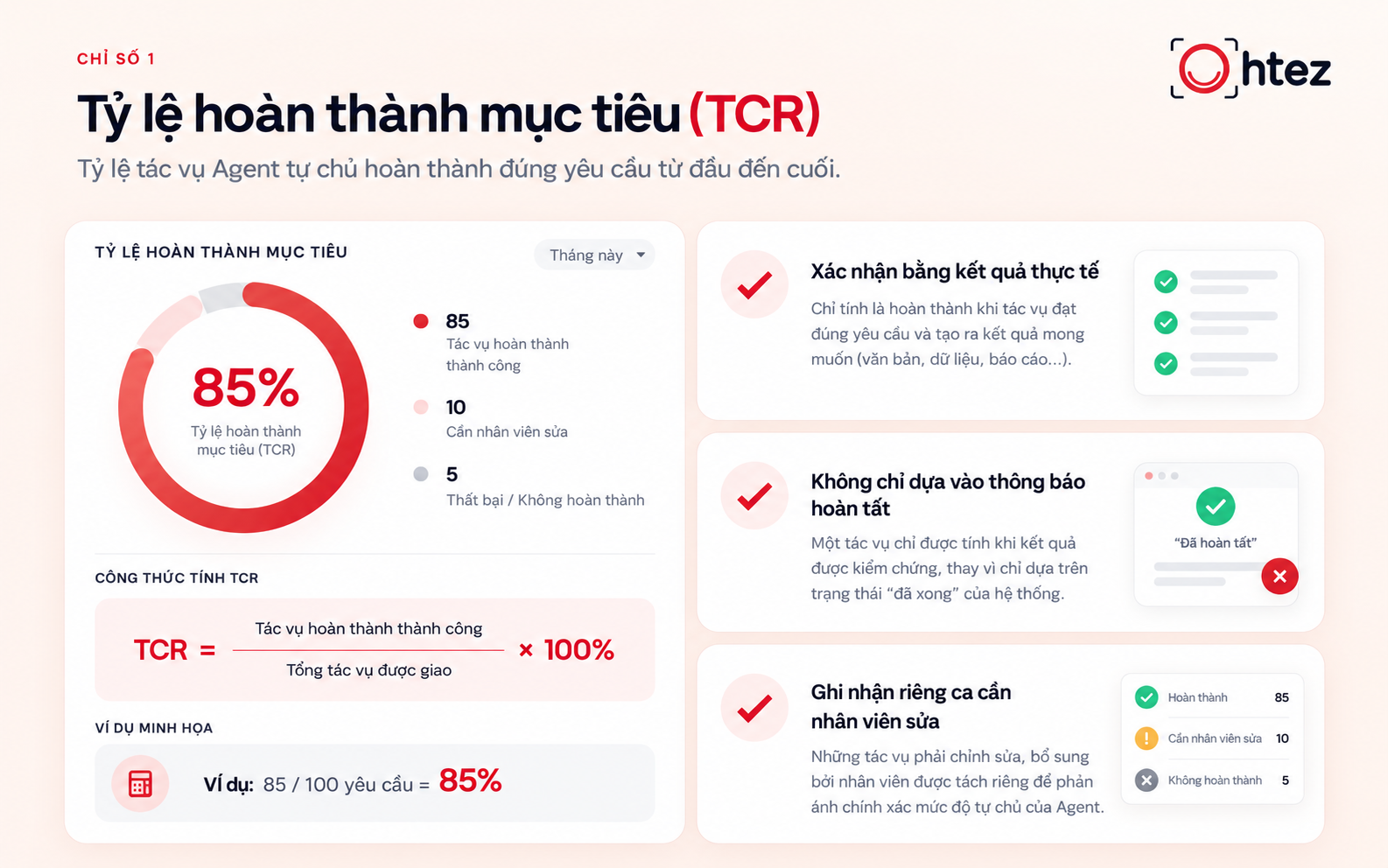
TCR measures how many tasks an AI Agent completes independently and correctly
2. Accuracy and hallucination control
This metric group measures the correctness of information, decisions, and actions in context. Businesses can compare results against a benchmark dataset, reference answers, or validated business rules. The proportion of outputs containing fabricated information should be monitored separately so serious errors are not obscured. For tasks involving API calls, teams should also check tool selection, input parameters, and execution outcomes.
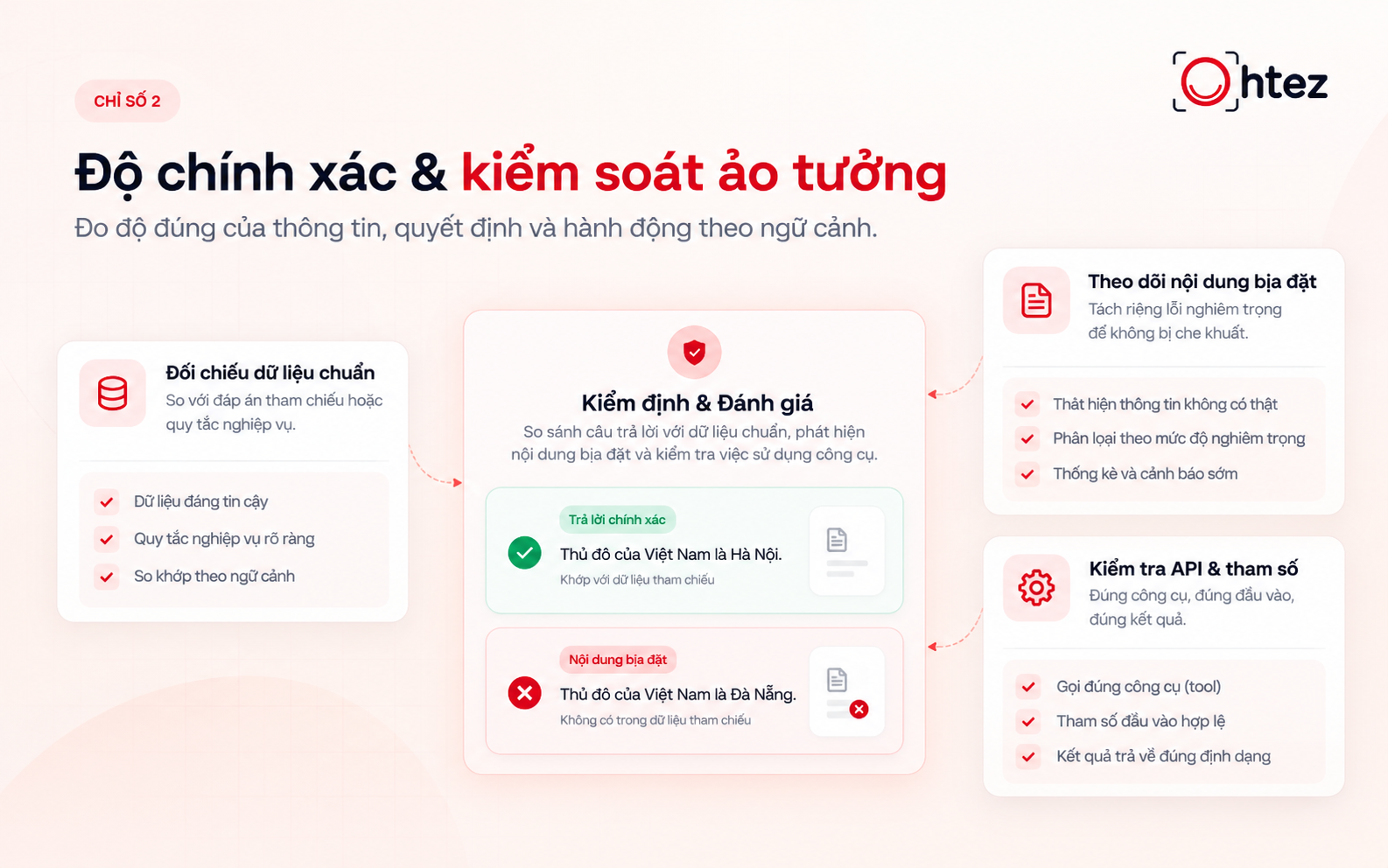
AI Agent performance evaluation through accuracy and hallucination prevention
3. Deflection and escalation rate
The deflection rate indicates how many requests are fully resolved without human intervention. The escalation rate represents requests handed over to a responsible employee as a proportion of all requests within the measured scope. A request that is not escalated is not necessarily resolved, as the customer may have abandoned it. These two rates do not always add up to 100% when failed, ongoing, or abandoned cases are included.

Deflection and escalation rates indicate the extent of automation
4. Resource efficiency and token cost optimization
This group tracks completion time, token usage, number of tool calls, and processing costs. In addition to average processing time, teams should examine unusually slow tasks to identify bottlenecks. Cost per successful task equals the total cost within the measurement scope divided by the number of successful tasks. This calculation also accounts for resources consumed by failed attempts.
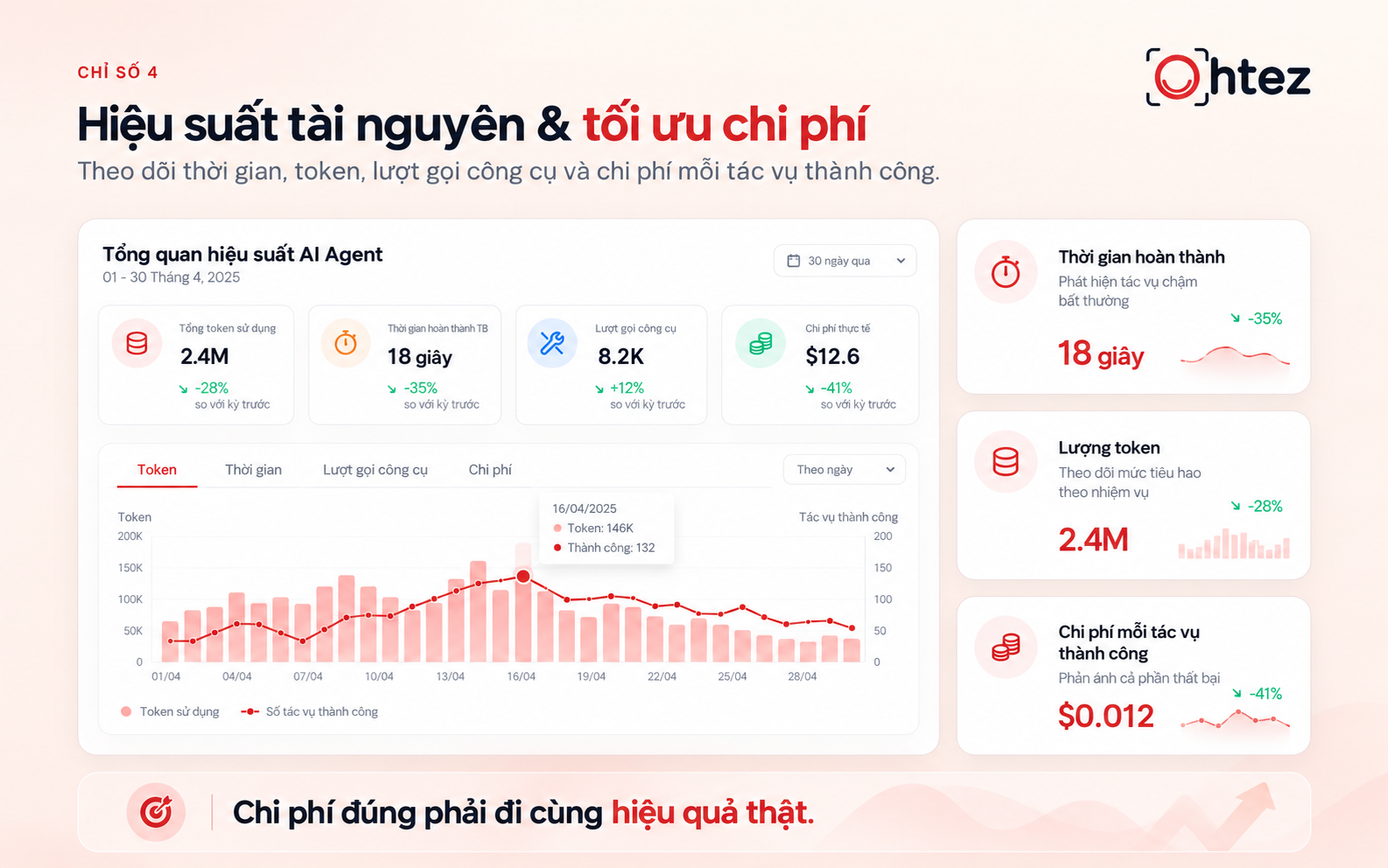
AI Agent performance evaluation must account for resource use and per-task costs
5. Safety and guardrails
Safety metrics reflect compliance with policies, data protection requirements, and authorized permissions. Warning signs include the disclosure of personal information, unauthorized actions, and skipped approval steps. Businesses should distinguish attempted actions that were successfully blocked from actions that actually took place. The absence of incidents in a small test sample is not sufficient evidence that a system is safe.
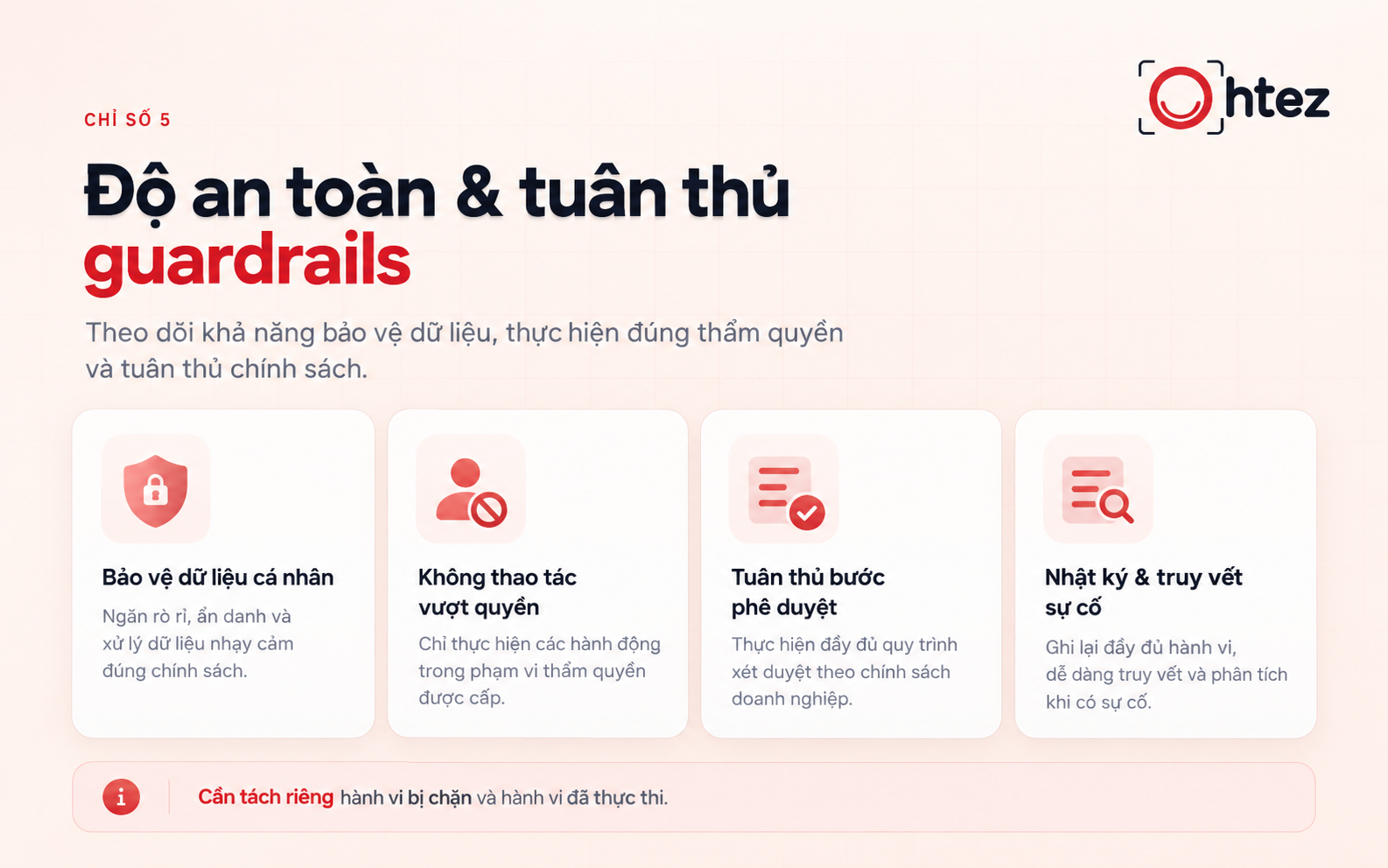
Assessing AI Agent data protection, access controls, and policy compliance
>> See also: Customer service AI Agent: A new customer service trend in 2026
AI Agent evaluation criteria to define before scoring
For AI Agent performance evaluation to reflect actual business requirements, companies need to establish core capabilities before assigning scores. The following three criteria focus on reasoning, security, and system integration.
Reasoning and tool-use capabilities
Reasoning ability is demonstrated by how an agent understands requests, breaks down tasks, and selects appropriate next steps. In AI Agent performance evaluation, teams should inspect observable actions rather than relying solely on explanations. The agent must know when to retrieve information, when to ask follow-up questions, and when to stop. Even a correctly selected tool can produce an invalid result if its parameters are wrong.
For example, a delivery address change requires checking whether the order is still eligible for modification. AI Agent evaluation criteria should cover the sequence of actions and the handling of exceptions. At this stage, AI Agent performance evaluation should also confirm that the system verifies a successful update before responding to the customer.

Three criteria for AI Agent performance evaluation before scoring
Data security and access control compliance
Access permissions should match the assigned task, account, and authorized data scope. During AI Agent performance evaluation, teams should test requests to access another person’s information or perform unauthorized operations. Correctly refusing such a request is a successful outcome; not every refusal should be counted as a failure.
When evaluating AI Agents, businesses must verify permissions at the execution-system level rather than relying exclusively on instructions in the prompt. Sensitive operations must follow the established approval workflow. AI Agent performance evaluation should also cover access logs and incident traceability. Logs themselves must protect sensitive information.
Integration capabilities and workflow scalability
A useful agent must connect reliably to the data sources and tools a business already uses. AI Agent performance evaluation should include API failures, missing data, and duplicate processing attempts. The system must communicate its status clearly and apply an appropriate recovery procedure. Retries must not create unintended additional transactions.
As traffic grows, AI Agent performance metrics should reflect both processing speed and success rate. Businesses should simulate concurrent requests under conditions close to production. AI Agent performance evaluation must also identify acceptable capacity limits. These results support scaling plans without compromising quality.
>> See also: Top 5 best free AI Agents in 2026, ready to use at no cost
AI Agent performance evaluation process for businesses
For consistent AI Agent performance evaluation, businesses need clearly defined objectives, test data, and scoring standards. The following five-step process explains how to prepare, measure, and monitor results, helping teams identify opportunities for improvement during operation.
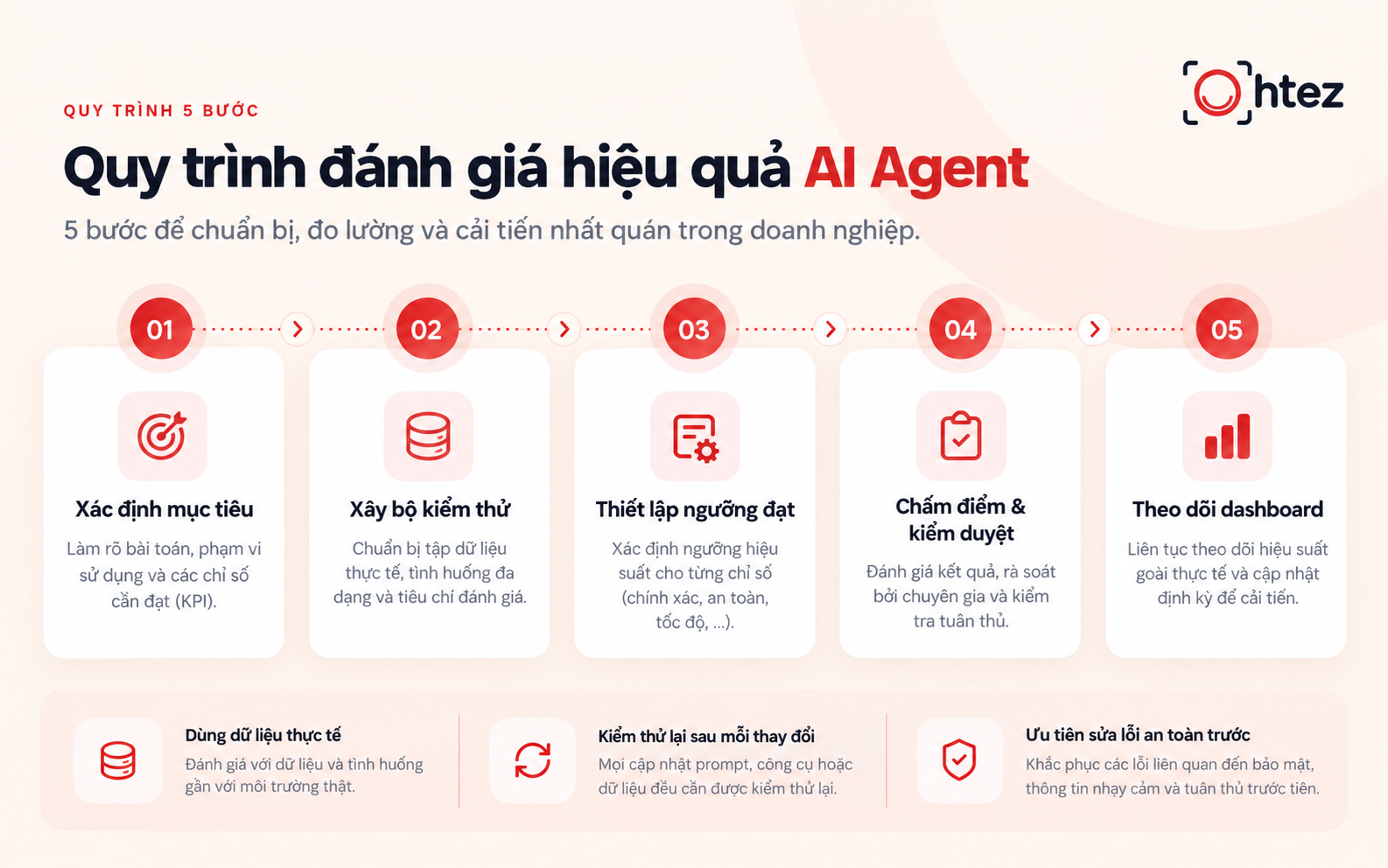
The five-step AI Agent performance evaluation process, from objectives to monitoring
1. Define objectives and pre-deployment baselines
To establish a reliable basis for AI Agent performance evaluation, businesses must define specific objectives and record baseline metrics.
- Choose tasks: Identify activities the agent should improve, such as looking up orders, handling requests, or compiling reports.
- Record the baseline: Measure processing time, error rates, and request volumes before deployment to establish a benchmark.
- Set targets: Define the intended outcome, such as shorter processing times while maintaining the accuracy required by the business process.
2. Build realistic, business-specific test scenarios
The test set should reflect actual workflows and define clear success conditions for each scenario.
- Prepare data: Select previously processed real-world requests, anonymize personal information, and specify the expected correct outcome.
- Diversify scenarios: Include common requests, complex cases, incomplete data, and situations where the agent must refuse or escalate.
- Verify results: Run each scenario multiple times and inspect the final state in the system rather than trusting a completion notification alone.
3. Set acceptance thresholds for each metric
AI Agent performance metrics need thresholds that reflect business requirements and risk levels.
- Target thresholds: Specify required levels for completion rate, accuracy, processing time, and cost per task.
- Warning thresholds: Define performance deterioration that calls for investigation, such as rising escalation rates or costs exceeding the agreed budget.
- Stop conditions: Specify when deployment must be suspended, particularly if an agent performs unauthorized actions or exposes data.
4. Combine automated scoring with human review
AI Agent performance evaluation should combine automated checks with reviews by business specialists to improve reliability.
- Automated checks: Compare transaction states, API parameters, and outputs against predefined success criteria.
- Business review: Examine samples of open-ended responses and high-risk cases to assess context, correctness, and usefulness.
- Align scoring standards: Document disagreements, clarify criteria, and update guidelines to reduce differences between reviewers.
5. Monitor dashboards and retest after every change
Measurement results should be monitored regularly and used to identify areas for improvement.
- Monitor dashboards: Display all five metric groups and segment results by task type to uncover issues hidden by averages.
- Run regression tests: Repeat the test suite after changes to the model, prompt, data, or tools to detect regressions in previously successful tasks.
- Prioritize improvements: Address safety issues and high-impact failures first, then optimize speed and cost before expanding scope.
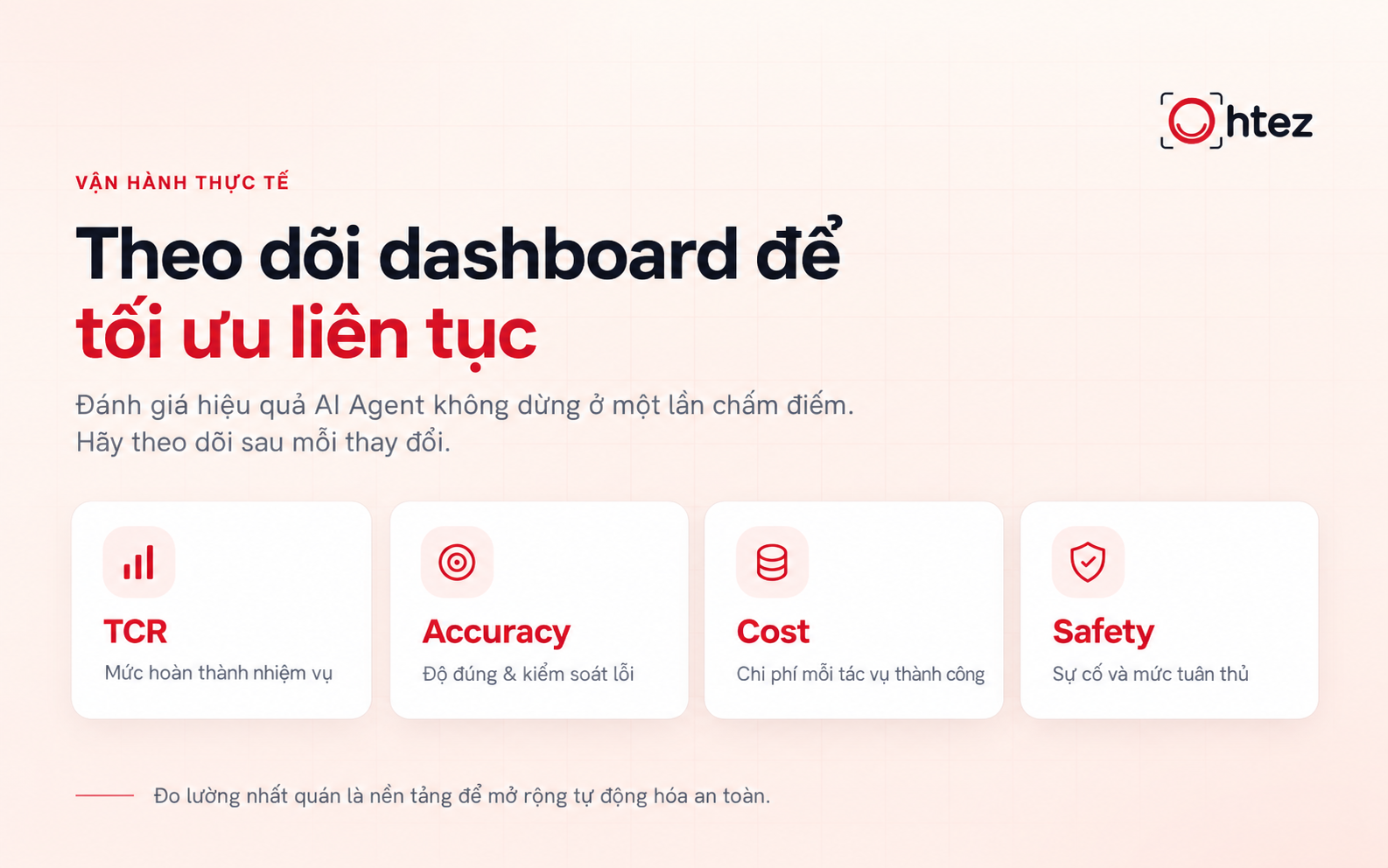
Dashboards support AI Agent performance evaluation and continuous improvement
AI Agent performance evaluation must consider execution outcomes, resource consumption, and compliance together. The five metric groups discussed here help businesses determine whether their systems complete the right tasks, reduce employee workloads, and operate within approved boundaries. For reliable results, establish baselines, test against real workflows, and monitor performance after each change. These practices provide a foundation for prioritizing improvements and deciding how to scale automation responsibly.