
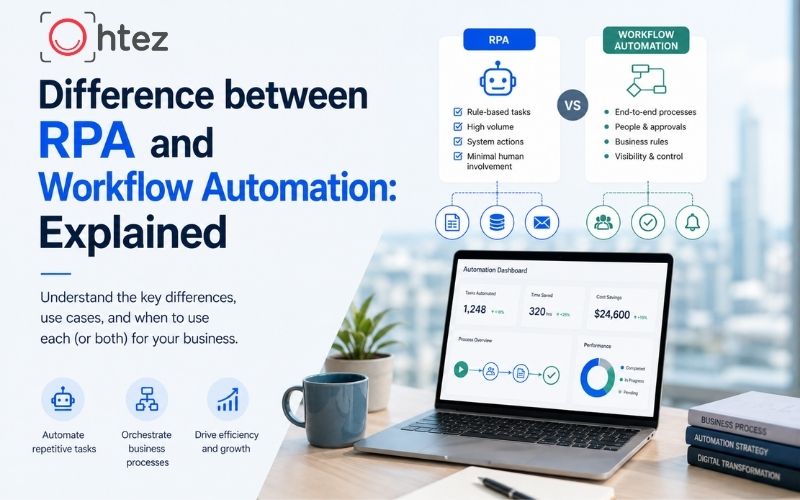
The difference between RPA and workflow automation lies in what each technology is designed to automate. RPA focuses on repetitive, rule-based tasks such as data entry, invoice processing, and report generation. Workflow automation, on the other hand, focuses on managing entire business processes by coordinating people, systems, approvals, and workflows. Although both technologies help improve efficiency and reduce manual work, they solve different operational challenges. Understanding how they differ is essential for choosing the right automation strategy. In this post, Ohtez will explain what RPA and workflow automation are, compare their key differences, and explore when businesses should use one or both solutions.
What is robotic process automation (RPA)?
Robotic Process Automation (RPA) is a technology that uses software bots to perform repetitive, rule-based tasks. Instead of employees manually entering data, generating reports, or transferring information between systems, RPA bots can complete these actions automatically.
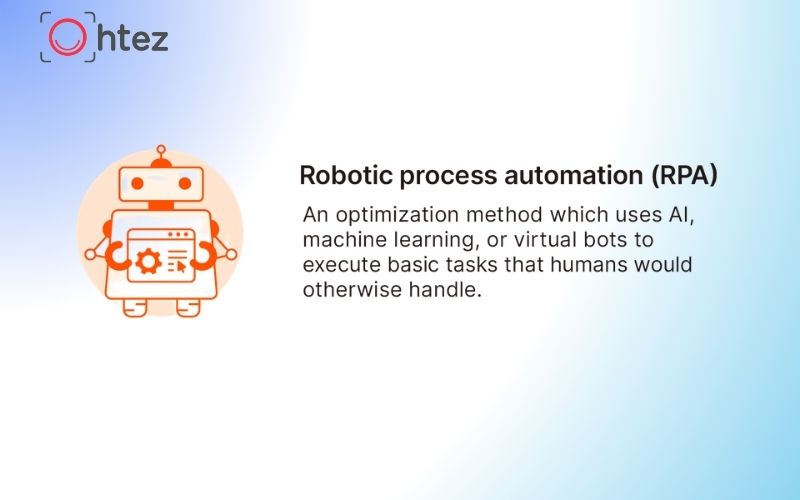
The easiest way to think about RPA is that it automates individual tasks rather than entire business processes. For example, an RPA bot can extract invoice data from emails and enter it into an accounting system without human intervention. Common RPA use cases include:
-
Data entry
-
Invoice processing
-
Payroll administration
-
Report generation
-
Data migration
In the context of the difference between RPA and workflow automation, RPA is primarily focused on task execution and operational efficiency. Understanding the difference between RPA and workflow automation helps businesses determine whether task automation alone is enough or if a broader process automation solution is needed.
What is workflow automation?
Workflow automation is the use of software to automate and manage the flow of work across people, departments, and systems. Instead of automating a single task, workflow automation ensures that an entire process follows predefined rules from start to finish.
For example, an employee onboarding workflow can automatically assign tasks to HR, IT, and managers, send notifications, and track progress without manual coordination. Common workflow automation use cases include:
-
Employee onboarding
-
Purchase approvals
-
Contract reviews
-
Leave request management
-
Customer support routing
When comparing the difference between RPA and workflow automation, workflow automation focuses on process orchestration rather than individual task execution. Evaluating the difference between RPA and workflow automation before implementing an automation strategy helps organizations select the right technology for their operational needs.
Difference between RPA and workflow automation
At first glance, RPA and workflow automation may seem similar because both aim to reduce manual work and improve operational efficiency. However, they solve different business challenges.
RPA focuses on automating repetitive tasks that follow predefined rules, while workflow automation manages how work moves across people, systems, and departments. In simple terms, RPA automates individual actions, whereas workflow automation automates entire business processes.
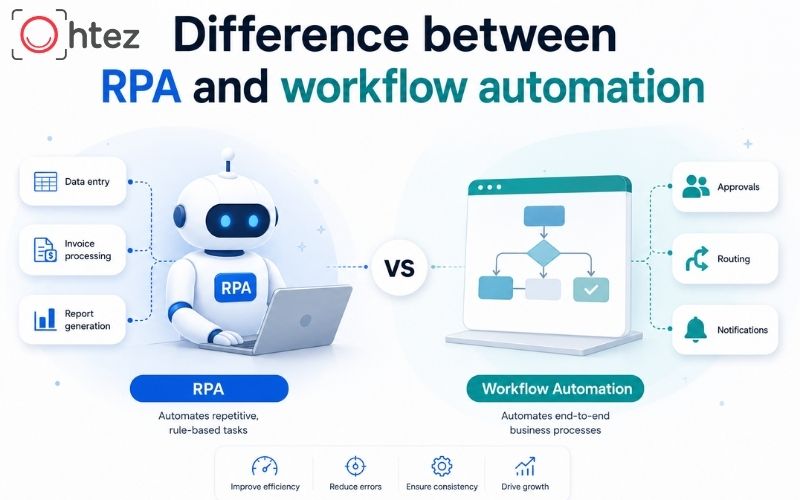
Understanding the difference between RPA and workflow automation is important because choosing the wrong technology can limit scalability and reduce automation ROI. While some organizations start with RPA for quick wins, others require workflow automation to streamline complex operations involving approvals, notifications, and cross-functional collaboration.
The table below highlights the key difference between RPA and workflow automation
|
Criteria |
RPA |
Workflow Automation |
|
Primary focus |
Individual tasks |
End-to-end processes |
|
Purpose |
Task execution |
Process orchestration |
|
Human involvement |
Minimal |
Often included |
|
Integration method |
User interface interactions |
APIs and system integrations |
|
Scalability |
Task-level scaling |
Enterprise-wide scaling |
|
Best suited for |
Repetitive, rule-based work |
Multi-step business workflows |
|
Examples |
Data entry, invoice processing |
Employee onboarding, purchase approvals |
|
Implementation speed |
Faster |
Moderate |
|
Maintenance |
May require bot updates |
Process updates and governance |
|
Business value |
Productivity gains |
Process optimization |
The table above summarizes the difference between RPA and workflow automation, making it easier to compare each technology based on business objectives, scalability, and implementation requirements.
>> See more: What are Integrated ERP Solutions? Definition & Benefits
When should you use RPA or workflow automation?
Choosing between RPA and workflow automation depends on the type of work you want to automate. While both technologies improve efficiency, they are designed for different business scenarios. Understanding the difference between RPA and workflow automation helps organizations avoid investing in the wrong solution and ensures automation efforts deliver long-term value.
Best use cases for RPA
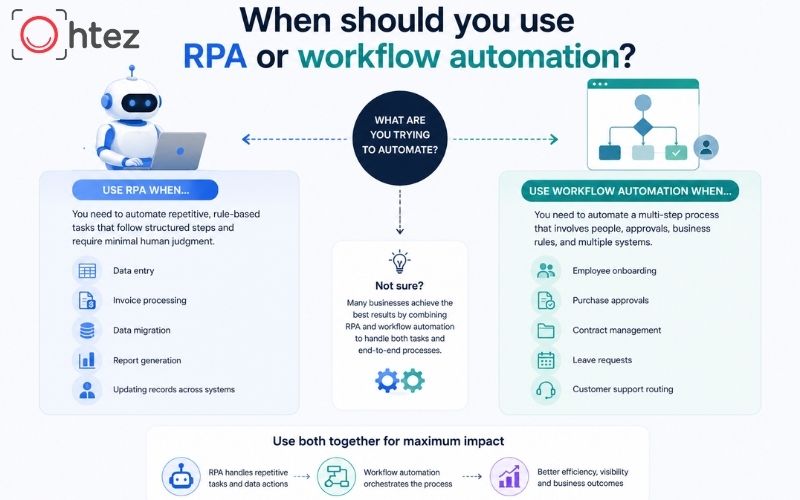
RPA is most effective when the goal is to automate repetitive, rule-based tasks that require little or no human judgment. Because software bots can mimic user actions, RPA works particularly well in environments where employees spend significant time on manual administrative work.
Typical RPA use cases include invoice processing, payroll administration, data migration, report generation, and customer data updates. It is also a practical solution for organizations that rely on legacy systems that do not support modern integrations.
When comparing the difference between RPA vs workflow automation, RPA is often the better choice if the objective is to achieve quick productivity gains without redesigning existing business processes.
Best use cases for workflow automation
Workflow automation is better suited for processes that involve multiple stakeholders, approvals, and business rules. Rather than automating a single task, it ensures work moves efficiently between people, departments, and systems according to predefined workflows.
Common examples include employee onboarding, purchase approvals, contract management, leave requests, and customer service escalation processes. These workflows often require visibility, accountability, and compliance controls that go beyond simple task automation.
In the context of the difference between RPA and workflow automation, workflow automation delivers the greatest value when organizations need to standardize and optimize end-to-end business processes.
>> See more: Data Integration Services: Smarter Data for Modern Businesses
When to combine both
In many cases, businesses do not need to choose between RPA and workflow automation. The most effective automation strategies combine both technologies to create a seamless end-to-end process.
For example, a workflow automation platform can manage the approval process for an invoice, route requests to the appropriate stakeholders, and track progress. At the same time, an RPA bot can extract invoice data, enter information into accounting software, and generate reports automatically.
This combination allows organizations to benefit from both process orchestration and task execution. Rather than viewing the difference between RPA and workflow automation as a choice between two competing technologies, many businesses achieve the best results by using them together as part of a broader automation strategy.
Why businesses often combine RPA and workflow automation ?
Understanding the difference between RPA and workflow automation helps businesses choose the right automation strategy, but in many cases, the best solution is not choosing one over the other. RPA and workflow automation address different parts of the same process and often deliver the greatest value when used together.
The role of RPA in process execution
RPA is best suited for repetitive, rule-based tasks such as data entry, invoice processing, and report generation. It improves speed, reduces manual effort, and minimizes human error without requiring major changes to existing systems.
The role of workflow automation in orchestration
Workflow automation manages how work flows across people, teams, and applications. It handles approvals, notifications, and process routing while providing visibility into the entire workflow. When combined with RPA, businesses can automate both individual tasks and end-to-end processes, creating a more scalable and efficient automation framework.
_20260626031052967)
Understanding the difference between RPA and workflow automation is key to choosing the right automation strategy. While RPA automates repetitive, rule-based tasks, workflow automation helps streamline and manage end-to-end business processes. By leveraging the strengths of both technologies, organizations can improve efficiency, reduce manual work, and build more scalable operations. For more insights on automation, AI agents, and digital transformation, follow Ohtez for the latest updates and practical guidance.
FAQs about RPA vs workflow automation

1. Is workflow automation better than RPA?
Not necessarily. Workflow automation and RPA solve different problems. Workflow automation manages business processes, while RPA automates repetitive tasks. The best choice depends on your automation goals.
2. Can RPA replace workflow automation?
No. RPA can automate individual tasks within a process, but it does not provide the orchestration, approvals, and governance capabilities offered by workflow automation platforms.
3. Which is easier to implement?
RPA is often faster to implement because it can work with existing systems without significant process changes. Workflow automation typically requires more planning but provides greater long-term scalability.