
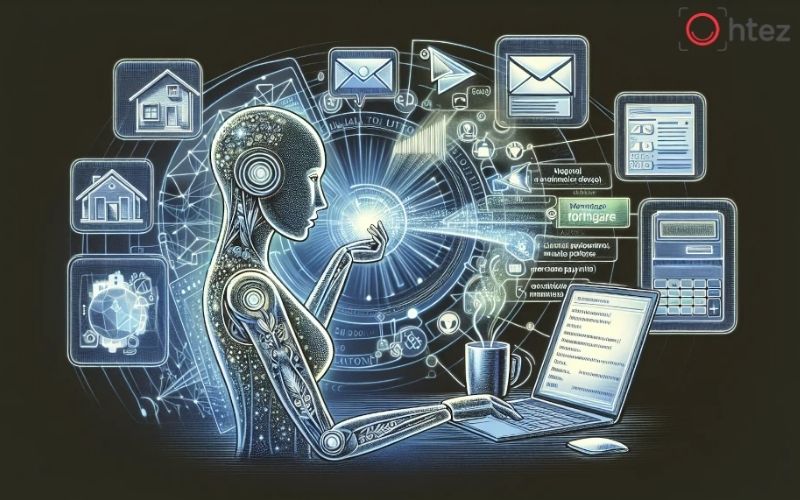
As artificial intelligence adoption accelerates, AI Agents and AI Chatbots have become two solutions that many businesses are considering to automate interactions, process data, and improve productivity. However, the two technologies differ significantly in autonomy, task execution capabilities, and scope of application. Understanding the AI Agent vs AI Chatbot comparison helps businesses avoid investing in the wrong technology and choose a solution that fits their actual needs. Join Ohtez as we examine their concepts, operating mechanisms, advantages, disadvantages, and the situations where each model is most suitable.
What is an AI Agent?
An AI Agent is an artificial intelligence system capable of receiving a goal, planning how to achieve it, and proactively calling APIs to execute multi-step workflows. In the AI Agent vs AI Chatbot comparison, autonomy and the ability to take real-world actions are the most fundamental differences. By combining LLMs with workflow automation, an Agent can outperform a conventional question-and-answer model when handling complex tasks.
>> See more: What is an AI Agent? How it works and detailed applications in 2026
How an AI Agent works
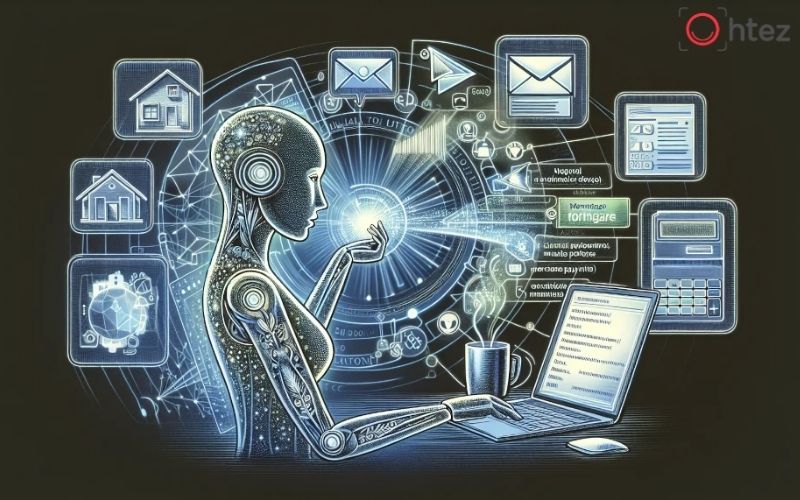
The AI Agent vs AI Chatbot comparison shows that an Agent’s planning mechanism stands out in complex, multi-step tasks
An AI Agent typically begins by receiving a goal or request from the user. The system uses natural language processing to identify intent, then analyzes data and selects the appropriate action. In the AI Agent vs AI Chatbot comparison, this planning mechanism gives Agents a clear advantage in complex tasks. A basic process may include:
- Receiving the request and identifying the goal to be completed based on the content, data, and interaction context.
- Breaking the goal into multiple steps, then selecting the tools or data sources required for processing.
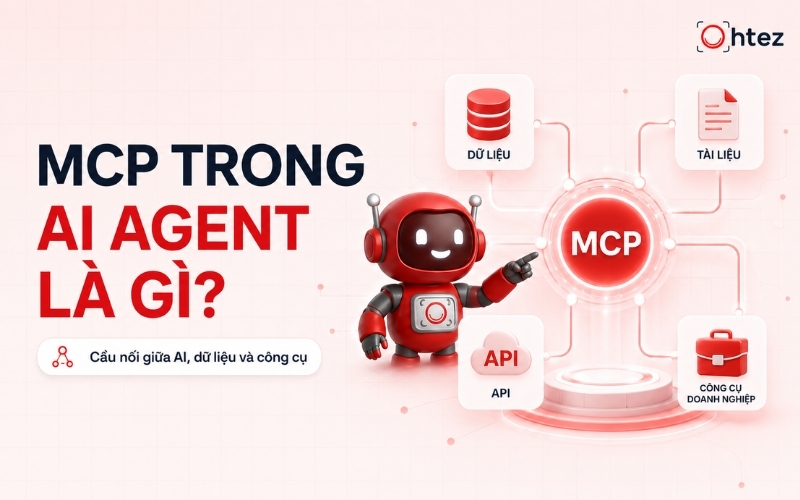
- Taking action through APIs, CRM, databases, or other software that the business has authorized the Agent to connect to.
- Checking the result and continuing to adjust the plan if the task has not yet met the original goal.
Advantages of AI Agents
The main advantage of an AI Agent is its ability to go beyond generating a response and directly help complete work. In the AI Agent vs AI Chatbot comparison, Agents are better suited to businesses that want to automate multi-step processes and make context-aware decisions. Key advantages include:
- Automatically completing a sequence of tasks instead of requiring employees to perform each step manually.
- Connecting to CRM, ERP, email, or internal systems to access the data needed to process requests.
- Personalizing actions based on transaction history, needs, and information provided by the user.
- Scaling intelligent automation processes as the business workload grows.
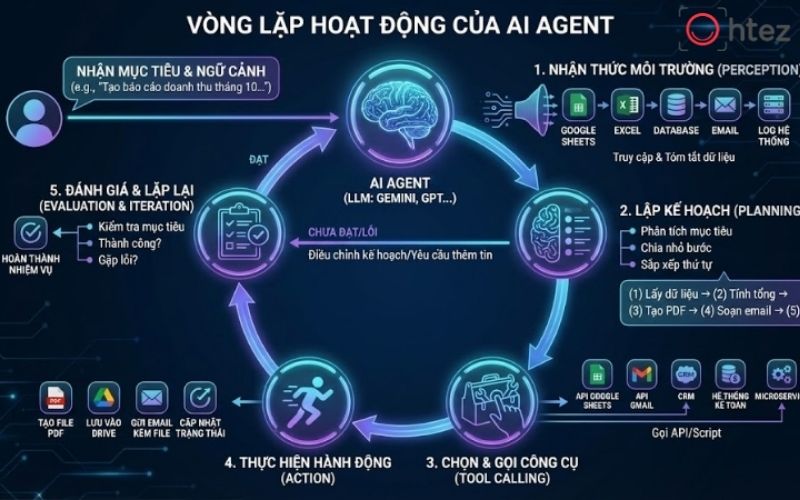
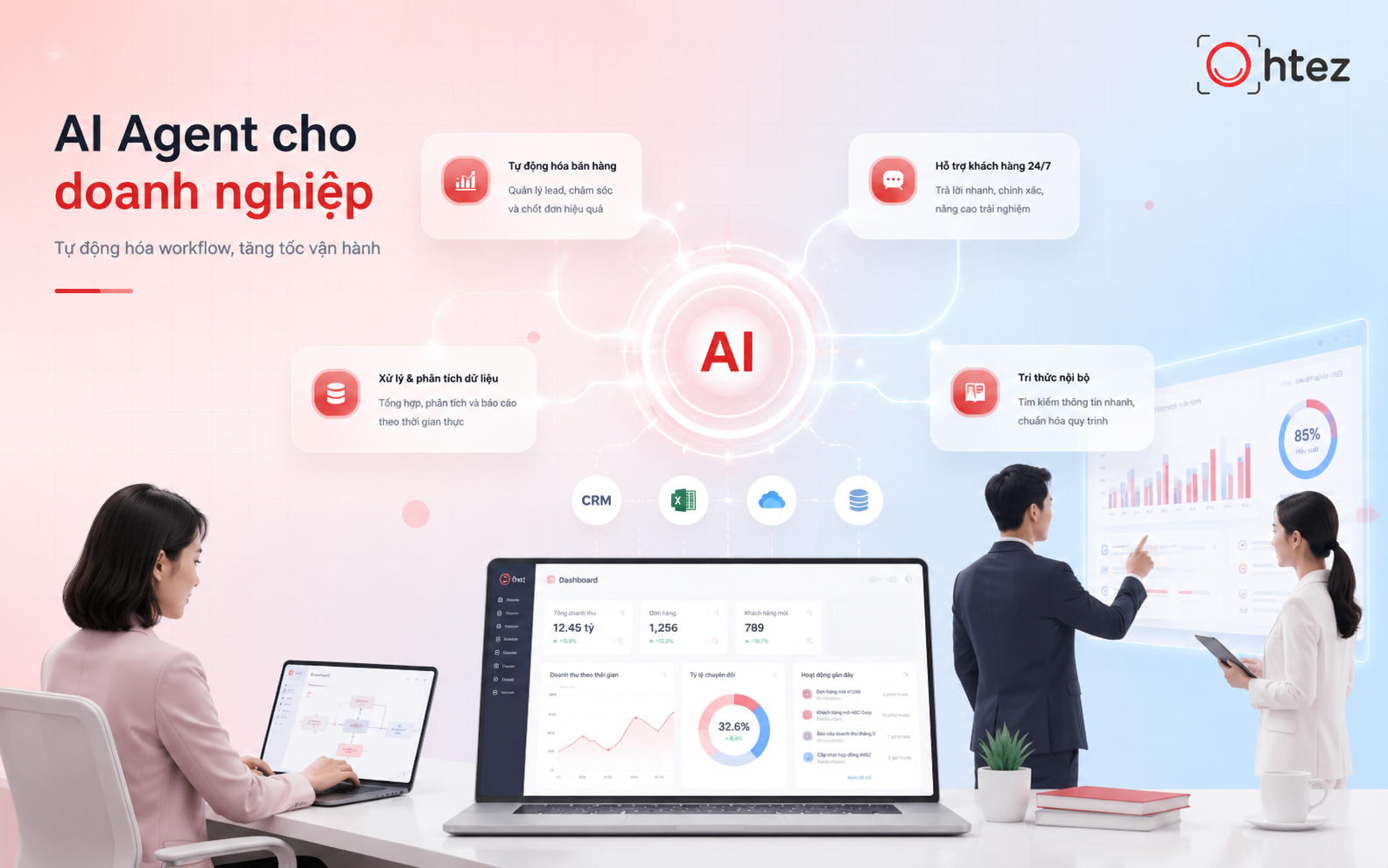
AI Agents can automatically complete a sequence of tasks and connect to CRM and ERP systems to access data for request processing
Disadvantages of AI Agents
AI Agents offer a high level of automation, but they also require businesses to tightly control how the system accesses data and takes actions. In the AI Agent vs AI Chatbot comparison, the cost and implementation complexity of an AI Agent are typically higher than those of a chatbot designed mainly for question-and-answer support. Limitations to consider include:
- A sufficiently stable data system and APIs are required so the Agent can retrieve information and execute tasks accurately.
- Improper access permissions can create security and data privacy risks.
- Complex workflows require thorough testing to reduce the risk of AI making unintended decisions or triggering unwanted actions.
- Build, monitoring, and maintenance costs are generally higher than for basic conversational AI solutions.
What is an AI Chatbot?
An AI Chatbot is software that uses artificial intelligence to communicate flexibly with users through text or voice. In the AI Agent vs AI Chatbot comparison, an AI Chatbot focuses primarily on responses and conversational support rather than autonomously completing an entire process. With NLP and LLM integration, this technology is highly effective for answering FAQs, providing service guidance, and receiving initial requests.
How an AI Chatbot works
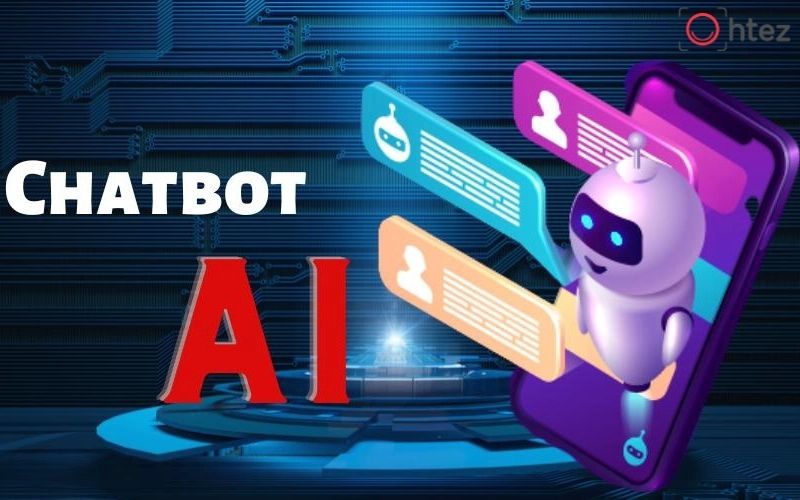
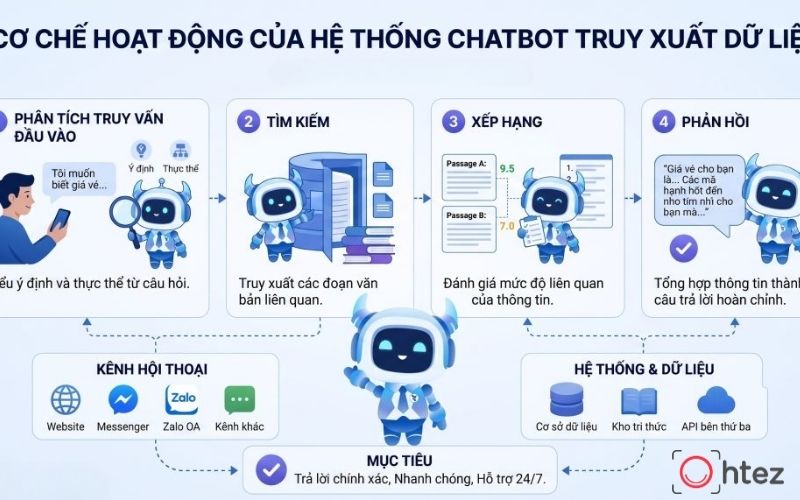
The AI Agent vs AI Chatbot comparison shows that AI Chatbots focus on conversational responses based on scripts or a knowledge base
An AI Chatbot receives a question, identifies the user’s intent, and then searches for relevant information to generate a response. The system may rely on predefined scripts, a knowledge base, or a generative AI model. In the AI Agent vs AI Chatbot comparison, a chatbot usually completes its role after providing information or handing the request over to an employee. The process typically includes:
- Receiving the message and analyzing its content with natural language processing to identify the user’s needs.
- Matching the question with data, documents, or scripts that the business has prepared and controlled in advance.
- Generating a context-appropriate response while maintaining the conversation within the current interaction session.
- Handing the conversation over to an employee when the chatbot lacks enough information or the case requires specialized handling.
Advantages of AI Chatbots
AI Chatbots are suitable for businesses that need to automate a large volume of repetitive questions without building an overly complex task-execution system. In the AI Agent vs AI Chatbot comparison, chatbots usually have an advantage in faster deployment and easier control over their operating scope. Common benefits include:
- Providing 24/7 customer responses, reducing wait times for frequently asked questions and basic needs.
- Handling multiple conversations simultaneously, reducing pressure on customer service teams during peak hours.
- Making it easy to build a centralized FAQ and knowledge base so information can be communicated more consistently.
- Keeping the cost of deploying a conversational chatbot more manageable than an AI system that executes multi-department workflows.
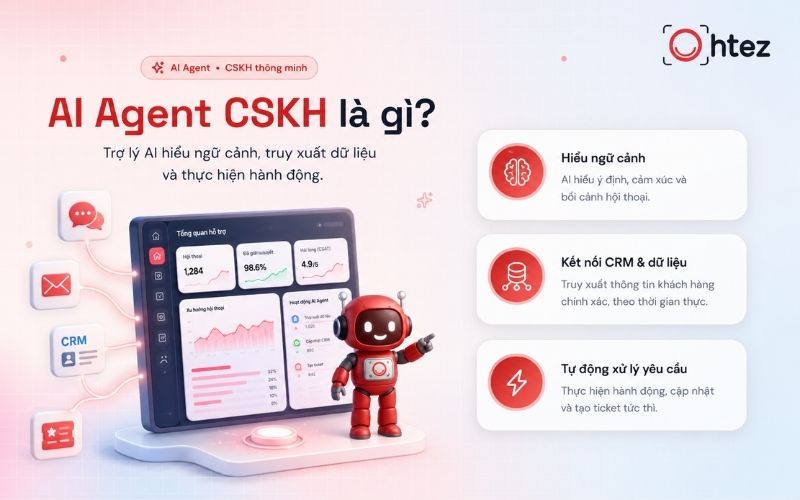
AI Chatbots can respond to customers 24/7 and handle multiple conversations simultaneously during peak hours
Disadvantages of AI Chatbots
Although chatbot conversations are becoming increasingly natural, chatbots still have limitations when users ask them to handle work beyond the configured data or conversation flow. This is a clear difference in the AI Agent vs AI Chatbot comparison when a task requires multiple automated execution steps. Common limitations include:
- Difficulty handling complex requests effectively when they require coordination across multiple systems or a sequence of decisions.
- Significant dependence on the quality of the knowledge base, training data, and the way the business designs its conversation flows.
- The possibility of inaccurate answers when the source data is outdated or when a question contains highly specific context.
- Many cases still require a human handoff so an employee can continue checking and resolving the customer’s request.
>> See more: AI Agent vs Workflow: Detailed comparison & how to choose the right approach
AI Agent vs AI Chatbot comparison: What’s the difference?
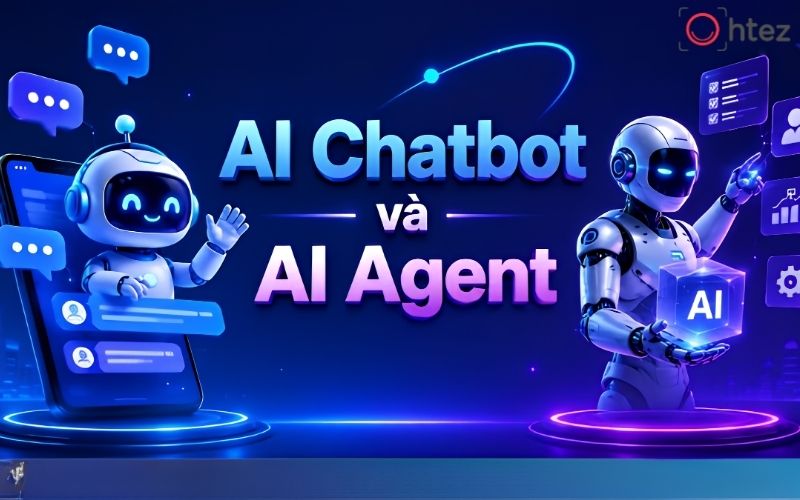
The AI Agent vs AI Chatbot comparison across five criteria reveals clear differences in goals, autonomy, and integration capabilities
The core difference in the AI Agent vs AI Chatbot comparison lies in their operating goals. A chatbot focuses on communication and providing answers, while an Agent aims to complete a goal by planning its own steps, using tools, and taking actions.
Therefore, the difference between an AI Agent and an AI Chatbot is not simply which one can “communicate better,” but mainly how much each system can act and automate.
When should you choose an AI Agent or AI Chatbot?
When to use an AI Chatbot
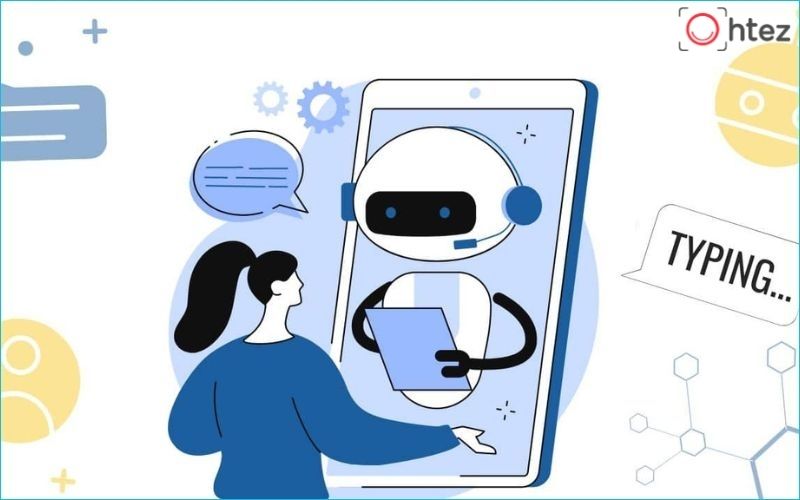
AI Chatbots are suitable when a business needs to answer frequently asked questions and collect basic customer information
AI Chatbots should be prioritized when the main goal is to improve response speed and reduce the number of simple questions employees must handle every day. In the AI Agent vs AI Chatbot comparison, not every process requires the high level of autonomy offered by an Agent. Chatbots are suitable for cases such as:
- Answering frequently asked questions about products, services, policies, operating hours, or the business’s registration process.
- Helping customers look up basic information without directly interacting with multiple business systems.
- Collecting names, needs, phone numbers, or other lead information before handing the customer over to a consulting or sales team.
- Businesses that need an automated customer service solution that is easy to deploy, easy to manage, and clearly scoped.
When to deploy an AI Agent
The AI Agent vs AI Chatbot comparison shows that Agents are better suited to processes that must collect data from multiple sources and automatically handle the next step
An AI Agent is appropriate when a business wants the system not only to respond but also to proactively handle subsequent steps. In the AI Agent vs AI Chatbot comparison, this is a strong option for processes involving multiple data sources, tools, and actions. An AI Agent may be suitable when:
- A request requires data to be collected from multiple sources, evaluated, and then used to select the next action for each situation.
- The business wants to automate workflows such as classifying requests, updating CRM, sending emails, or creating tasks for employees.
- The process needs to maintain long-term context and use interaction history to personalize how each customer is handled.
- A high task volume makes manual processing time-consuming and reduces productivity across several related departments.
>> See more: What are AI Agents and Agentic AI? A detailed A-Z comparison
Can AI Agents replace chatbots?
The AI Agent vs AI Chatbot comparison shows that the two technologies can still work together instead of completely replacing one another
AI Agents have a broader operating scope, but that does not mean chatbots will disappear completely. In the AI Agent vs AI Chatbot comparison, each technology is still better suited to a different group of tasks. A business that only needs to answer FAQs does not necessarily need to invest in a complex Agent system.
In practice, a hybrid model can be more effective. Chatbots can handle simple interactions with clearly defined flows, while Agents can process requests that require data retrieval or multiple actions. For sensitive cases, employees should still review and approve important steps. The future of AI automation is therefore more likely to involve collaboration among chatbots, Agents, and humans than one technology completely replacing another.
Challenges of implementing AI Agents and chatbots
Both technologies depend on data quality, system architecture, and how the business controls outputs. Therefore, the AI Agent vs AI Chatbot comparison is only the first step; real-world performance also depends heavily on implementation and AI governance. Businesses should pay particular attention to:
- Protecting customer data through access controls, encryption, and limits on the information that AI systems are allowed to access.
- Regularly standardizing and updating the knowledge base to reduce inaccurate, outdated, or policy-inconsistent answers.
- Thoroughly testing API integrations before allowing an Agent to automatically take actions that affect operational data.
- Establishing monitoring and human-in-the-loop mechanisms for critical processes, financial activities, or decisions with a high level of risk.
The AI Agent vs AI Chatbot comparison is only the first step; real-world effectiveness also depends on implementation and data governance
A clear understanding of the AI Agent vs AI Chatbot comparison helps businesses choose technology based on actual needs rather than trends. AI Chatbots are well suited to question-and-answer support, customer service, and simple processes; AI Agents are more effective when workflows require multiple automation steps, data connectivity, and proactive task execution. Businesses should start with a specific problem and assess their data, systems, and costs before scaling. If you need to build an AI solution that fits your operating processes, contact Ohtez for guidance on implementation and choosing the right model.