
In the digital age, customers increasingly expect quick answers and support whenever they need it. This creates pressure on businesses to improve service quality while making the most of their resources. An AI chatbot for business helps automate customer communication, handle inquiries, and personalize the customer experience. Its flexible applications can improve operational efficiency and strengthen a company’s competitive position. This article explores the benefits, real-world use cases, popular solutions, and steps involved in implementing AI chatbots effectively.
What is an AI chatbot for business?
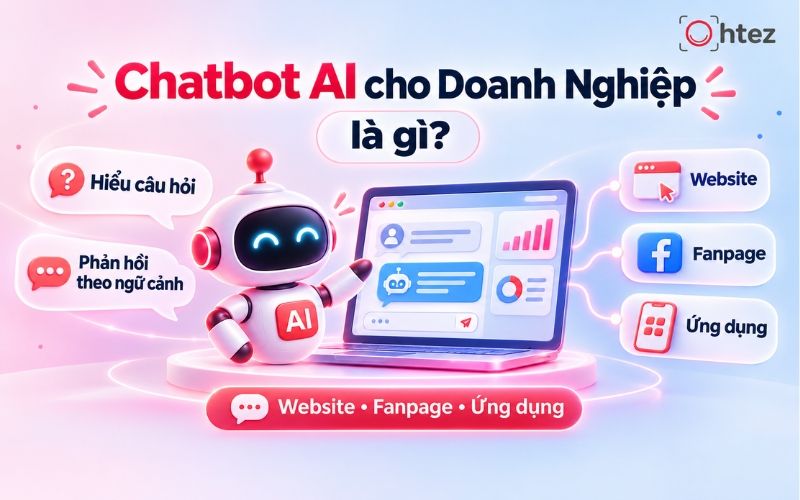
Chatbot AI cho doanh nghiệp là gì?
An AI chatbot for business is a conversational system that uses artificial intelligence (AI) to receive, analyze, and respond to user requests. Unlike traditional chatbots that follow fixed scripts, it can understand different ways of asking a question, retain conversational context, and generate more flexible responses. In practice, an AI chatbot for business typically combines natural language processing (NLP), large language models (LLMs), and relevant data sources. Its workflow generally consists of four main stages:
- Receive requests: The chatbot receives questions through a website, social media page, or application, then analyzes the content to identify the user’s intent.
- Retrieve information: The system searches for relevant information in internal documents, a knowledge base, or integrated software.
- Generate responses: The AI model uses the retrieved information and conversation context to formulate an appropriate answer.
- Control the outcome: The chatbot applies business rules and transfers requests to a human employee when they fall outside its scope.
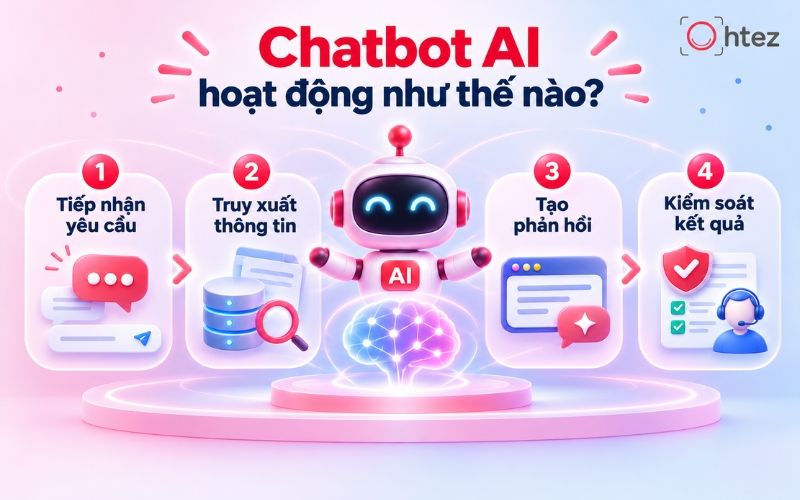
Chatbot AI hoạt động như thế nào?
>> Read more:What does AI Agent mean? How it works and its applications in 2026
How is an AI chatbot different from a traditional rule-based chatbot?
When choosing an AI chatbot for business, it is important to distinguish it from a traditional rule-based chatbot. Both can automatically respond to customers, but they differ in how they process information, interpret context, and handle conversations flexibly. The table below summarizes the key differences.
|
|
Traditional chatbots are suitable for simple requests, while an AI chatbot for business supports more flexible conversations and can handle more complex situations. Businesses should choose a solution based on their actual needs, available data, and budget.
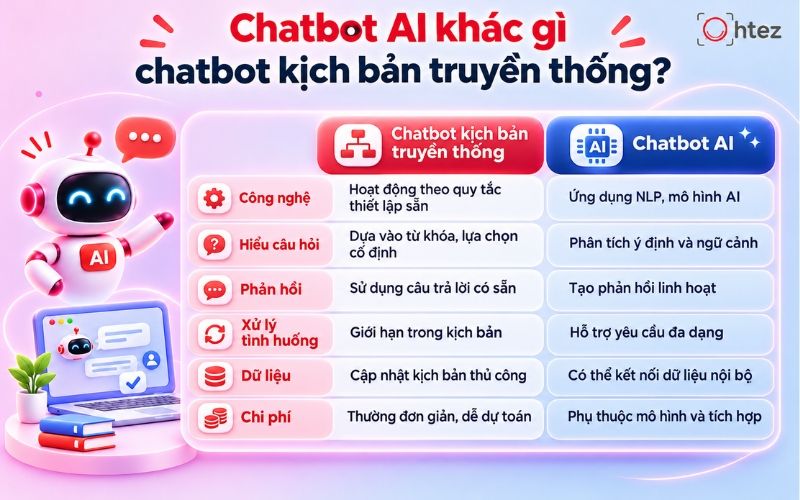
Comparison between AI chatbots and traditional chatbots
Benefits of an AI chatbot for business
Using an AI chatbot for business offers benefits across customer management, sales, and operations. Beyond automating repetitive tasks, this technology can improve service quality and help companies use their resources more efficiently. The following are three key advantages.
1. Reduce workloads and operating costs
An AI chatbot for business can automatically answer common questions about products, pricing, policies, and orders without requiring an employee to respond individually to every request. Because it can operate continuously, the chatbot reduces manual workloads and helps prevent teams from becoming overwhelmed during peak hours. Businesses can assign employees to more complex tasks, making better use of time and operating budgets
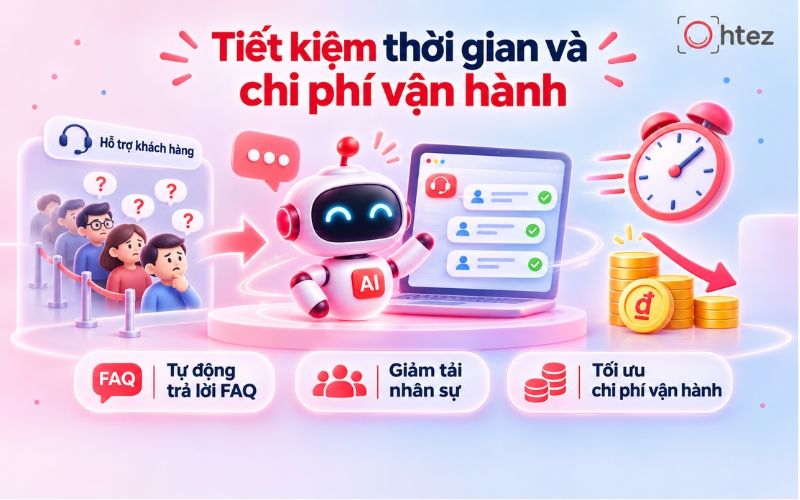
Reduce workloads and operating costs
2. Respond to customers quickly, 24/7
With rapid response capabilities, an AI chatbot for business gives customers access to information at any time without waiting for an employee. The system can retain conversational context, answer questions, and provide guidance tailored to each request. When a complex issue arises, it can pass the relevant information to a human agent, supporting a seamless experience and higher customer satisfaction.
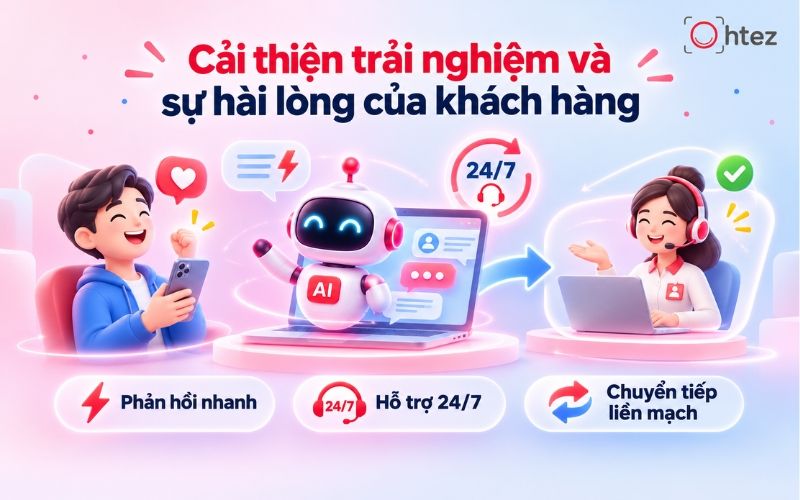
Respond to customers quickly, 24/7
3. Automatically collect and categorize customer information
An AI chatbot for business can automatically collect customer information during interactions, including needs, budgets, and contact details. Based on the information customers provide, the chatbot can group them by level of interest or purchasing needs. When connected to a customer relationship management (CRM) system, this data can be stored and passed to the sales team, making it easier to follow up, prioritize consultations, and provide appropriate support.
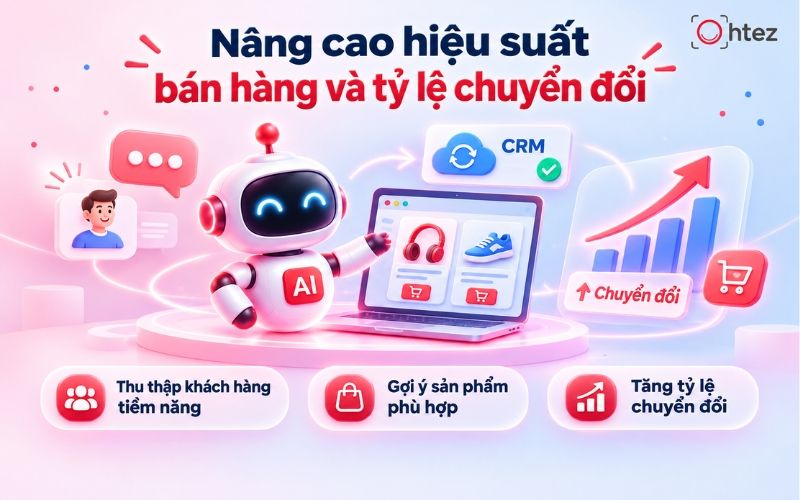
Automatically collect and categorize customer information
>> Read more:How to use an AI Agent: A detailed beginner’s guide for 2026
Practical applications of AI chatbots in business
An AI chatbot for business can be used in customer service, sales support, and internal operations. The technology helps automate repetitive tasks, save time, and improve productivity. Here are some of the most common real-world applications.
1. AI chatbots for customer service
An AI chatbot for business can receive and respond to customer questions through websites, social media pages, or apps. When connected to the right data, it can provide product information, explain warranty policies, guide returns and exchanges, and check order status. For complex requests, the chatbot can transfer the conversation to a human employee along with the interaction history, helping ensure consistent support.
2. AI chatbots for product recommendations and sales support
In sales, an AI chatbot for business can recommend products based on a customer’s needs, budget, and preferences. It can suggest suitable options, answer questions about prices and promotions, and guide customers through placing an order. When integrated with a CRM, the chatbot can also capture contact information, qualify leads, and pass customer data to the sales team for further consultation.
AI chatbots for customer service and sales support
3. AI chatbots for information retrieval and internal operations
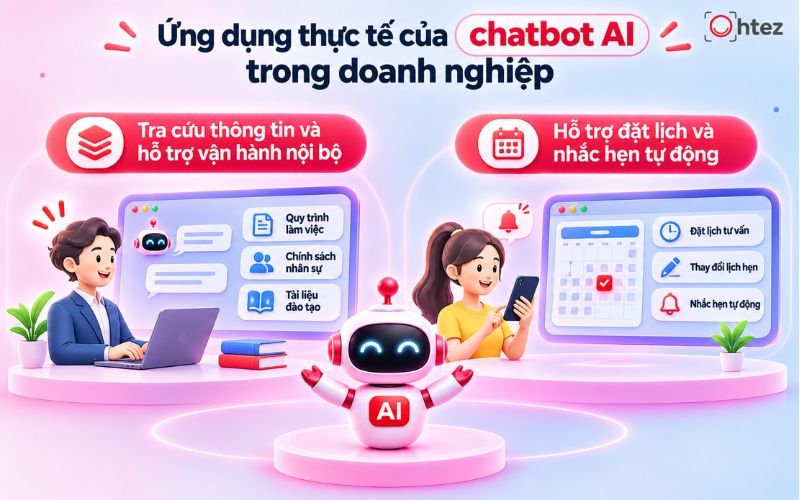
An AI chatbot for business can also help employees find information and handle internal work. Connected to a knowledge base, it can retrieve operating procedures, HR policies, training documents, and task instructions. For example, an employee can ask about the approval process for a proposal rather than searching through multiple documents manually. Appropriate access permissions are essential for protecting internal data.
4. AI chatbots for automated scheduling and appointment reminders
An AI chatbot for business can help customers book consultations, register for services, or reschedule appointments within a conversation. When integrated with a calendar management system, it can check availability, record booking details, and send confirmations. This use case is particularly relevant to clinics, education centers, and service businesses that manage large numbers of appointments.
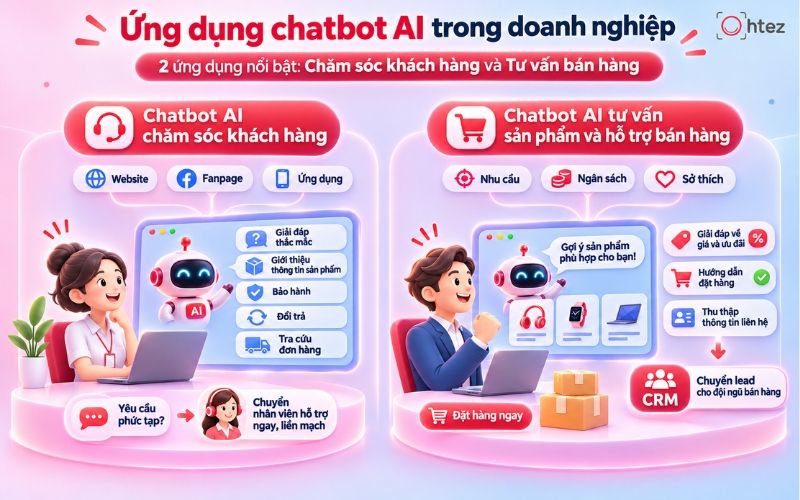
AI chatbots for internal operations and automated appointment scheduling
>> Read more:What is workflow automation? A guide to optimizing business processes
How to implement an AI chatbot for business
To implement an AI chatbot for business effectively, companies need a roadmap aligned with their goals, data sources, and existing systems. The process typically includes four key steps, from defining requirements to measuring performance and making improvements.
Step 1. Define goals and use cases
Before implementing an AI chatbot for business, a company should identify its objectives, such as customer service, sales consultation, or internal support. It should assess real needs, the volume of common inquiries, and available resources. This makes it easier to select suitable features and avoid spending on unnecessary functionality.
Step 2. Standardize data and build conversation flows
Data quality directly affects the performance of an AI chatbot for business. Businesses need to consolidate product information, policies, frequently asked questions, and operational documents. They should then verify accuracy, remove outdated information, and establish conversation rules so the chatbot can respond appropriately.
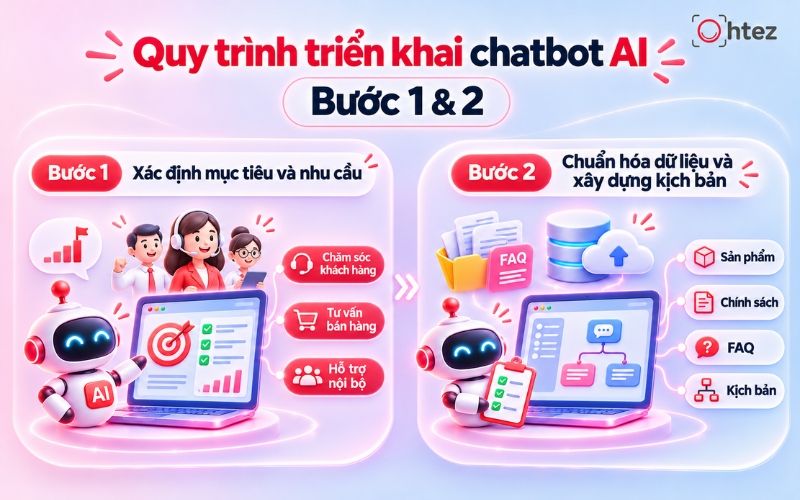
Steps 1–2: Define objectives and standardize AI chatbot data
Step 3. Integrate systems and test the chatbot
Once the data is prepared, the AI chatbot for business can be integrated with a website, social media page, CRM, or other relevant platform. Businesses should test its ability to understand questions, retrieve information, and respond across real-world scenarios. They should also establish a handoff process to human employees for requests the chatbot cannot resolve.
Step 4. Measure performance and optimize operations
Businesses should assess an AI chatbot for business using metrics such as response time, request resolution rate, and customer satisfaction. Conversation data can reveal questions that were not answered accurately. Companies can then update the knowledge base, adjust rules, and improve the chatbot’s performance.
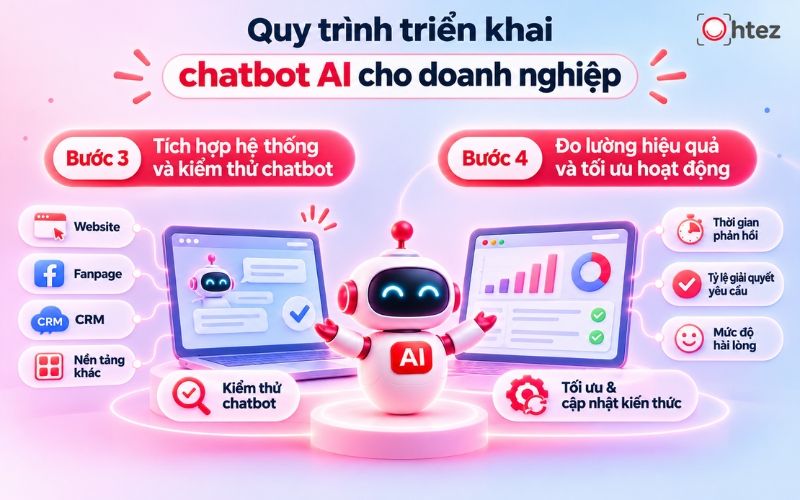
Steps 3–4: Integrate, test, and optimize AI chatbots for business
An AI chatbot for business is creating new opportunities for companies to improve customer interactions and organize their operations. However, the real value of AI lies in solving the right problems and fitting existing workflows. For businesses looking to take automation further, OHTEZ’s AI Agent service offers consulting, design, and integration solutions for bringing AI into existing systems. Contact OHTEZ to discuss a solution aligned with your business goals.