
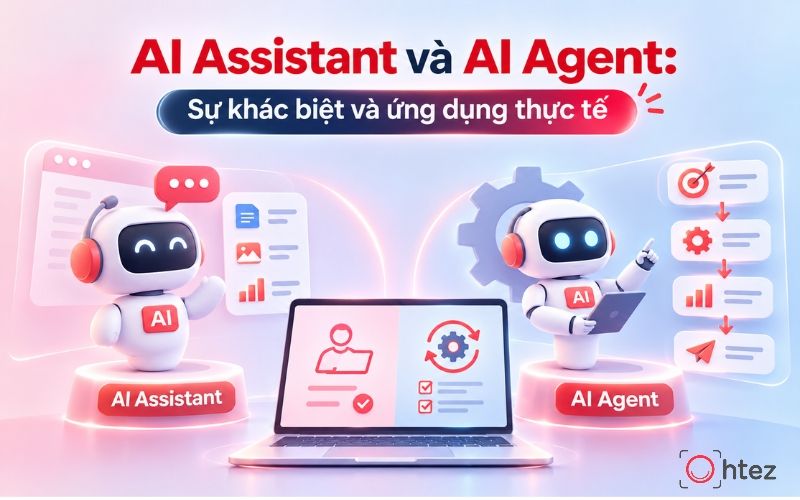
Artificial intelligence is becoming increasingly common in both workplaces and business operations. Among the technologies attracting attention, AI Assistants and AI Agents stand out for their ability to help people work more efficiently and streamline tasks. However, many still confuse these two concepts or are unsure how they differ in practical applications. So how do AI Assistants and AI Agents differ in practice, and which solution best meets your business needs? This AI Assistant and AI Agent guide explores both questions in detail.
What is an AI Assistant?
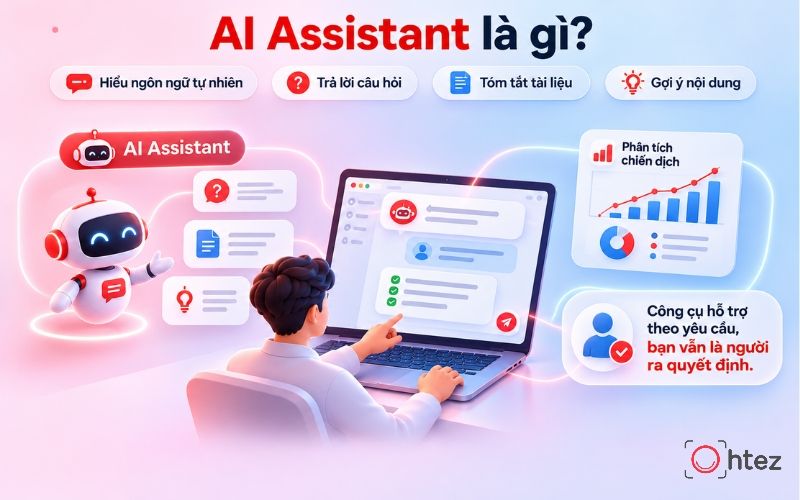
An AI Assistant is an artificial intelligence system designed to help users perform tasks in response to specific requests. It can understand natural language, process information, and generate responses based on the input it receives. For example, a marketing employee might ask an AI Assistant to write advertising copy, summarize documents, or analyze campaign results. The assistant then generates content or recommendations for the employee to review and use. In addition to providing on-demand support, AI Assistants have several notable characteristics:
- On-demand assistance: Receives questions, processes information, and responds according to user instructions.
- Direct interaction: Users initiate requests, review the output, and decide what to do next.
- Support for a wide range of tasks: Can search for information, create content, analyze data, and answer questions.
- Tool integration: Some advanced AI Assistants can connect to software and perform actions within their granted permissions.
What is an AI Assistant?
What is an AI Agent?
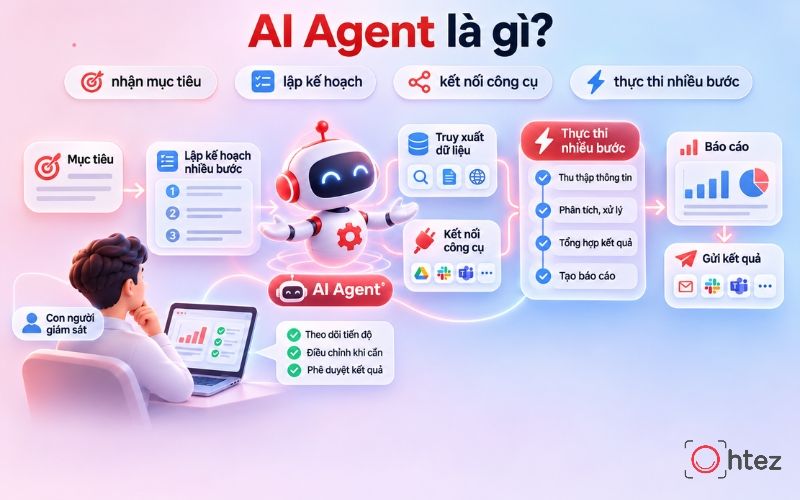
An AI Agent is an artificial intelligence system capable of receiving an objective, creating a plan, and carrying out a sequence of actions to complete a task within its authorized scope. Rather than asking an AI tool to assist with each step of preparing a revenue report, a business can give an AI Agent an objective: “Compile this week’s revenue and send a report to the manager.” If authorized, the system can retrieve data, perform calculations, generate the report, and send it to the person in charge. AI Agents also have several key characteristics:
- Task autonomy: Can carry out tasks without requiring human guidance at every step.
- Planning and execution: Breaks objectives into smaller steps, determines the sequence, and takes appropriate actions.
- Coordination across tools: Can connect to APIs, software applications, and data systems to handle a series of tasks.
- Controlled operation: Operates within granted permissions, while important actions still require human supervision or approval.
What is an AI Agent?
>> Read more:What does AI Agent mean? How it works and practical applications in 2026
AI assistant vs AI agent: A comparison across six criteria
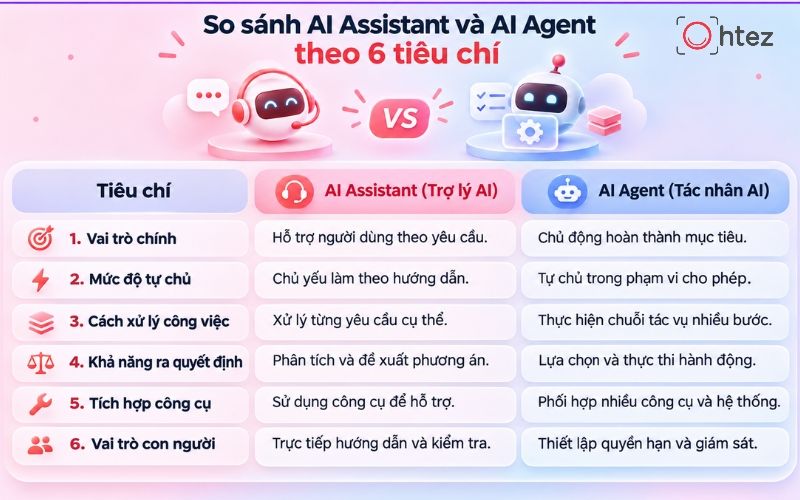
To understand the differences between AI Assistant and AI Agent, it is important to consider their roles, levels of autonomy, and ability to perform tasks. The six criteria below highlight the defining characteristics of each technology.
AI assistant and AI agent: A comparison across six criteria
1. Primary role
An AI Assistant acts as a helper, supporting users as they process information, answer questions, and complete specific requests. Its focus is on assisting people throughout their work and reducing the time spent on everyday tasks. By contrast, an AI Agent acts as an executor, proactively taking actions to achieve an assigned objective. Rather than simply providing information or suggesting options, it focuses on carrying out tasks.
2. Level of autonomy
An AI Assistant typically works in response to direct user requests and instructions. It mainly performs assigned tasks and often needs further human interaction before it can continue. An AI Agent, on the other hand, can identify the necessary steps, adjust its actions, and continue working without constant instructions. However, its actual level of autonomy still depends on its configuration and granted permissions.
3. How tasks are handled
An AI Assistant usually handles individual requests, such as searching for information, analyzing data, or generating content. Once the output is ready, the user can review it and complete the remaining steps. An AI Agent can instead break a broader objective into smaller tasks, develop a plan, and execute the steps in an appropriate sequence. It can also check results and adjust its approach when necessary.
4. Decision-making capabilities
An AI Assistant primarily analyzes information and provides suggestions or recommendations for users to consider. People generally make the final choice and carry out the action, especially for important tasks. Unlike an AI Assistant, an AI Agent can assess a situation, select an option, and take action based on its assigned objectives, available data, and predefined rules. High-risk decisions still require human oversight or approval.
5. Tool integration capabilities
An AI Assistant can connect to software, databases, and external tools through APIs. These integrations mainly support information retrieval or help users complete specific requests. An AI Agent can proactively select and coordinate multiple tools, APIs, or systems within the same workflow. The key difference is its ability to orchestrate tools to complete a sequence of interconnected tasks.
6. Human oversight and control
When using an AI Assistant, people typically submit requests, monitor responses, and review the results before proceeding. Humans remain in direct control of the process. With an AI Agent, people primarily define objectives, set execution limits, and monitor outcomes. The system can handle multiple steps independently, but important tasks still require appropriate controls and approval mechanisms.
>> Read more: AI Agent vs Workflow: A detailed comparison and how to choose
When should businesses use an AI Assistant or AI Agent?
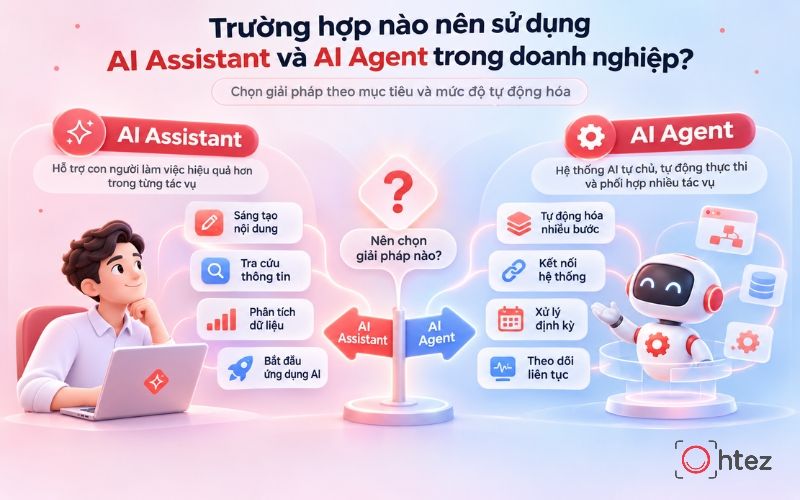
When should businesses use an AI Assistant or AI Agent?
Choosing between AI Assistant and AI Agent depends on the nature of the work, the desired level of automation, and the business’s operational needs. Each technology is better suited to certain use cases, as outlined below.
1. When should businesses use an AI Assistant?
In an AI Assistant vs AI Agent evaluation, an AI Assistant is suitable when a business needs help completing tasks but still wants employees to review and control the results directly. Common use cases include:
- When creating content: Helps employees brainstorm ideas, write advertising copy, draft emails, or prepare documents based on their requests.
- When looking up information: Searches internal documents and answers questions about products, policies, or work procedures.
- When analyzing data: Compiles figures, identifies trends, and suggests options for users to consider before making decisions.
- When first adopting AI: Supports simple tasks that do not yet require deep system integration or end-to-end business process automation.
2. When should businesses use an AI Agent?
When comparing AI Assistant and AI Agent, businesses should consider an AI Agent if they need a system that can proactively handle multiple steps and coordinate tools to achieve an objective. Suitable scenarios include:
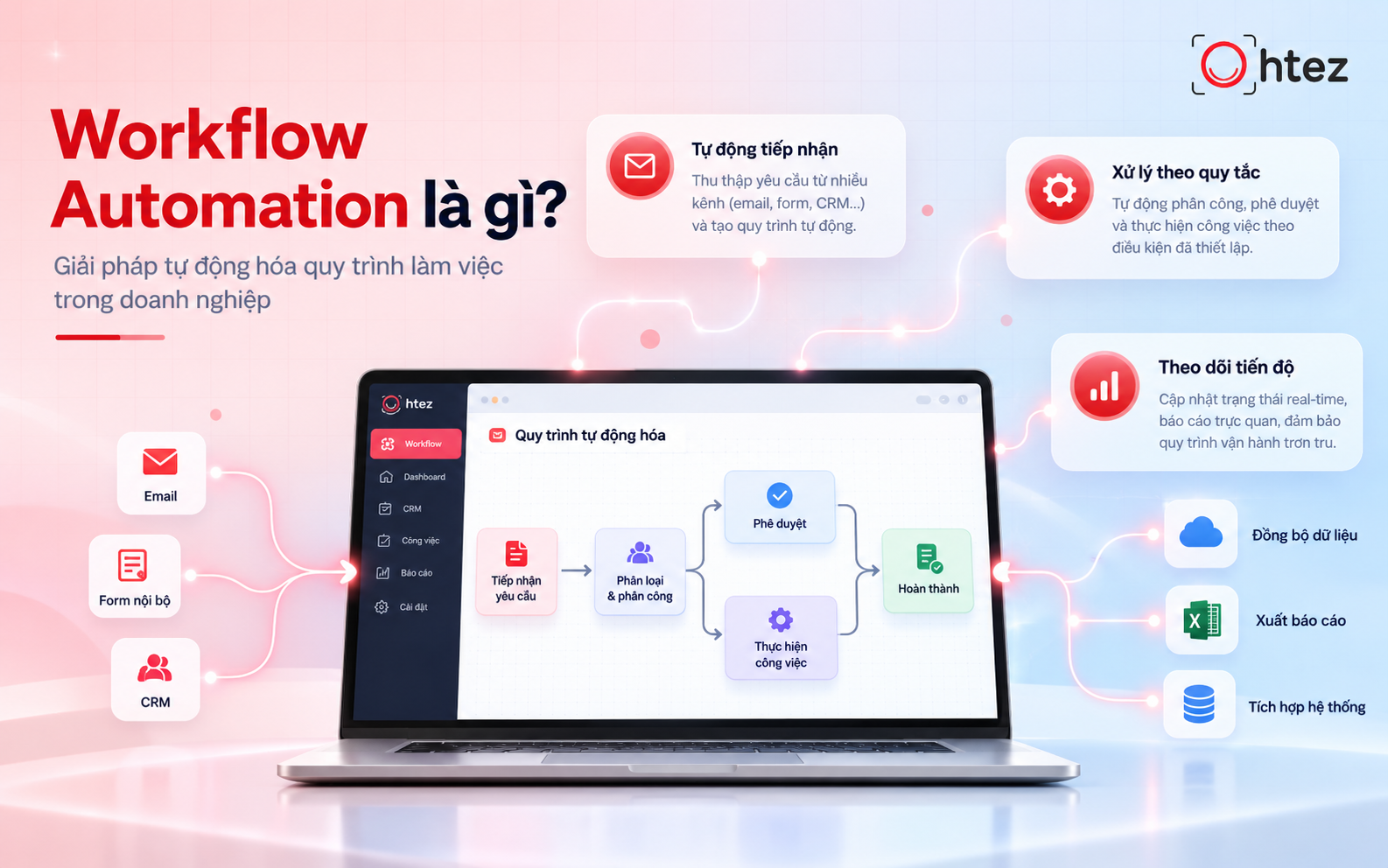
- When automating multi-step workflows: Receives requests, classifies information, performs the necessary steps, and updates results according to a defined process.
- When connecting multiple systems: Coordinates data across CRM, ERP, and internal software without requiring continuous manual intervention.
- When handling recurring tasks: Automatically collects data, compiles reports, and delivers results on a schedule or when triggered by an event.
- When monitoring and acting continuously: Tracks task status, detects issues, and takes appropriate actions within its authorized scope.
How to implement AI Assistant and AI Agent effectively in business
To implement AI Assistant and AI Agent effectively, businesses need a rollout plan aligned with their goals, workflows, and available resources. The following steps are particularly important.
1. Define objectives and scope of use
Before implementing AI Assistant and AI Agent, businesses should identify tasks that consume substantial time or are prone to errors. An AI Assistant may be the first choice for information lookup, analysis, or drafting tasks. For multi-step processes requiring coordination across systems, an AI Agent may be more suitable. Clearly defined objectives help businesses select the right solution and avoid spreading investments too thin.
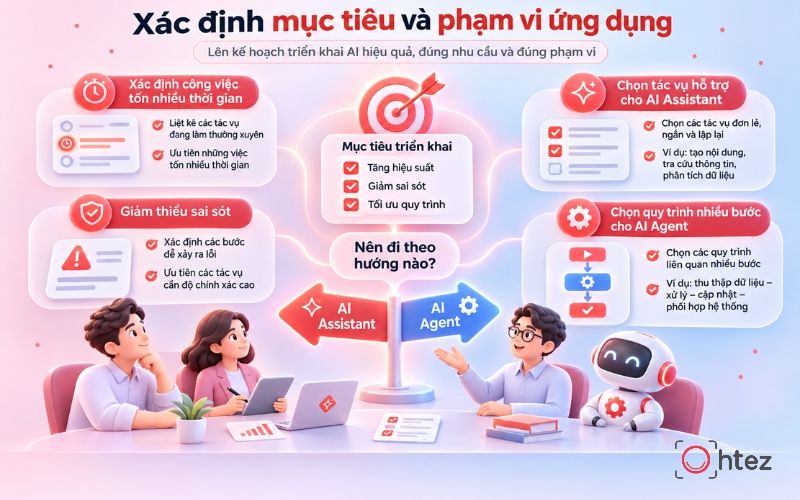
Define objectives and scope of use
2. Prepare data and integrated systems
Data quality directly affects the performance of AI Assistant and AI Agent. Businesses should standardize documents, operational information, and workflows before bringing them into the system. For an AI Assistant, complete and reliable data helps generate more relevant responses. For an AI Agent, businesses should also verify connections to CRM, ERP, or internal software to ensure stable task execution.
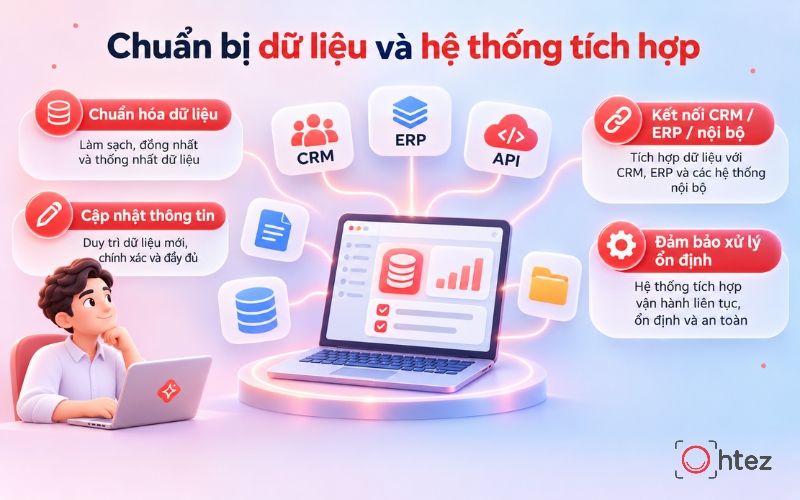
Prepare data and integrated systems
3. Set permissions and oversight mechanisms
When adopting AI Assistant and AI Agent , businesses need to define data access permissions and the scope of tasks each system is allowed to perform. Actions involving finances, customer information, or other sensitive business data should include human approval. Activity logs should also be monitored, and contingency procedures should be in place in case the system encounters errors. These measures help reduce risks and strengthen control.
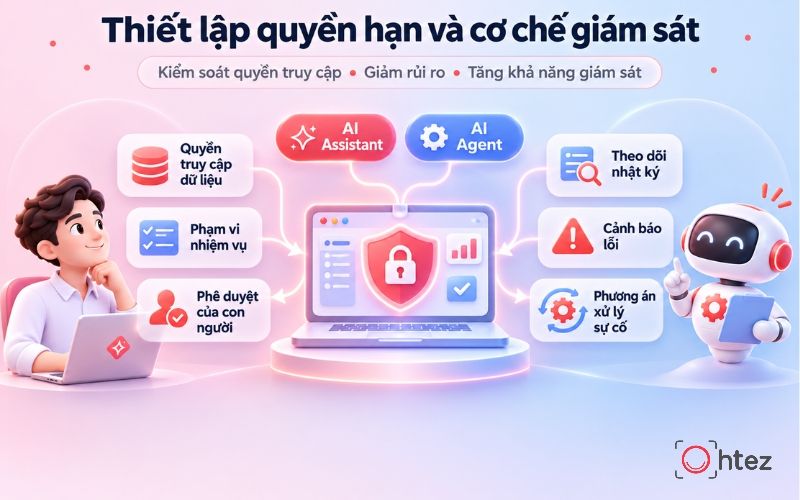
Set permissions and oversight mechanisms
4. Pilot and evaluate performance
Businesses should first test AI Assistant and AI Agent on a specific set of tasks before scaling up. Metrics such as processing time, accuracy, task completion rate, and operating costs should be reviewed regularly. Pilot results help identify tasks that deliver tangible benefits and issues that need refinement. Deployment should only be expanded once the solution meets the stated objectives.
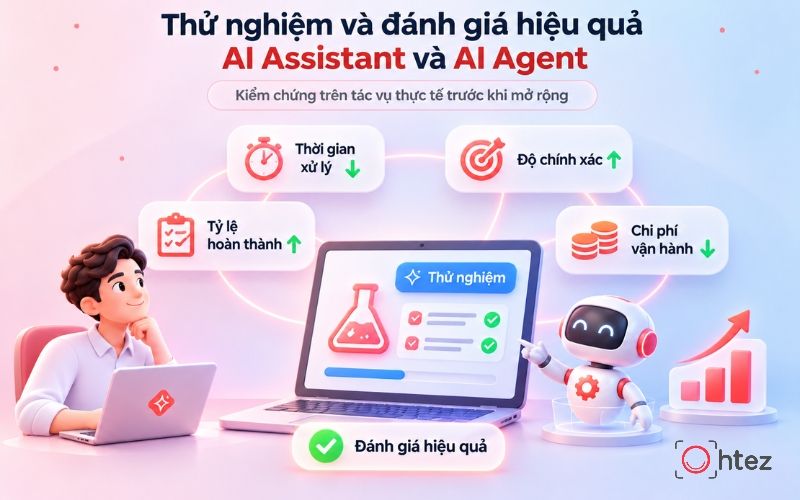
Pilot and evaluate performance
Understanding the differences between AI Assistant and AI Agent is a starting point for businesses looking to adopt artificial intelligence more effectively. However, the real value of AI does not come from using the most advanced technology; it comes from solving practical problems and delivering long-term benefits. Businesses need a clear direction to apply AI in ways that support their needs and growth objectives. If you are looking for an AI Agent solution for your business, contact OHTEZ for advice and a solution tailored to your operations.